This is for competitors, not spectators
I spend my days in federal IT at Inspired Solutions. We are an 8(a) and SDVOSB company. Here is what I keep seeing: a sharp founder finds a solicitation that looks perfect, gets excited, starts pricing, and then hits a wall. SAM is expired. NAICS is wrong. The capability statement is a Word dump. Or there is no past performance trail.
Federal buyers do not owe you a second look. When the paperwork is missing, they stop reading. Not because they dislike you. Because risk and compliance force them to.
This quick reference is the bid-ready stack I teach from how we actually compete. Seven documents. Get the folder right before you touch the solicitation.
In This Quick Reference
The 7 documents at a glance
Print this mental checklist. You are not bid-ready until each box is real, current, and findable in under five minutes.
UEI + Active SAM
Unique Entity ID and active SAM.gov registration. Renew every 365 days. No contract without both.
Reps & Certs
Representations and certifications inside SAM: size, ownership, compliance attestations buyers rely on.
NAICS codes
What you can bid. Drives set-asides and size standards. List more than one you can honestly perform.
Capability statement
Your federal resume. One or two pages. Lead with results, differentiators, and clear contact paths.
Past performance
Proof you deliver. If you are new, start as a subcontractor and document everything.
SB certifications
8(a), WOSB, HUBZone, SDVOSB and related status via MySBA / SBA when you qualify.
W-9 & license
Tax ID paperwork and active business license. These expire and change more than people check.

- Read Document 01 and 02 first. Entity gates kill pursuits before strategy matters.
- Build the capability statement and past-performance library in parallel with NAICS clarity.
- Only then load the hunt plan (bonus section) and run the 30-day calendar.
- Re-open this guide before every new lane or vehicle chase as a red-team checklist.
UEI + Active SAM.gov
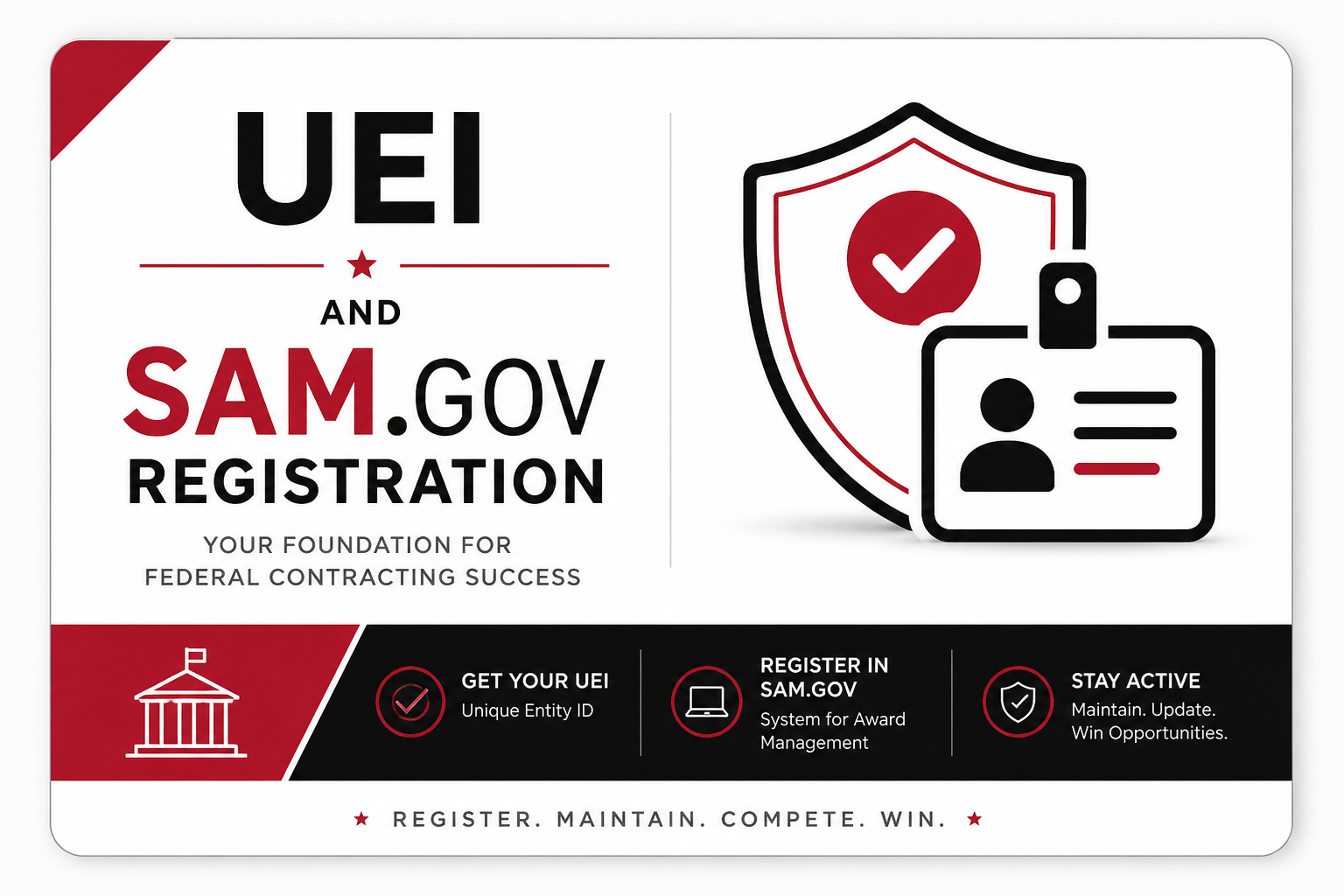
Your Unique Entity Identifier and an active System for Award Management registration. Without both, you are not eligible for award.
What it is
The UEI replaced DUNS as the government’s official entity identifier. SAM.gov is the system where entities register to do business with the federal government. Your record must show Active, not Expired, Incomplete, or Submitted. Registration renews on a 365-day cycle. When people say “get on SAM,” they mean a complete, active registration tied to the correct legal entity, banking data, and points of contact.
Why federal buyers care
Contracting officers cannot award to an entity that is not active in SAM. Primes often cannot onboard you as a sub if your SAM is wrong or expired. If registration lapses mid-pursuit, you can lose the bid, the award, or the ability to invoice. This is not a soft preference. It is a hard gate baked into procurement systems and policy.
How to get and maintain it
- Create or claim your entity at SAM.gov. Use the exact legal name that matches your formation documents and tax records.
- Complete every required section: core data, assertions, reps and certs, points of contact, and financial information as prompted.
- Confirm your UEI on every proposal cover page, capability statement, teaming agreement, and invoice packet.
- Set calendar reminders at 60 and 30 days before annual renewal. Assign a primary owner and a backup.
- After any address, banking, or ownership change, update SAM immediately. Do not wait for renewal season.
Common mistakes
- Assuming “we submitted it” equals Active. Check the status field yourself.
- Letting the only admin leave the company with the login.
- Using a DBA or marketing name that does not match the legal entity in SAM.
- Starting a chase with an expired registration and hoping to fix it later.
Treat SAM renewal like payroll. Someone owns the date. Someone verifies Active before every pursuit. Hope is not a renewal strategy.
Rick Piña- UEI documented and matches SAM exactly
- SAM status = Active (screenshot saved to bid folder)
- Renewal date on shared calendar with 60 / 30 day alerts
- Entity administrator + named backup
- Legal name matches formation docs, W-9, and bank
Representations & Certifications in SAM
The attestations inside SAM that tell buyers who you are, how big you are, how you are owned, and what you certify under federal rules.
What it is
When you register in SAM, you complete representations and certifications covering business size, ownership and control, socioeconomic status, and a range of compliance statements. Many solicitations pull or reference those answers instead of re-collecting everything on paper. Your reps are part of your official footprint. They are not marketing copy.
Why federal buyers care
Wrong size status, stale ownership data, or incomplete reps create protest risk and award risk. Buyers need clean, consistent answers that match your proposal narrative, your certificates, and reality. If marketing claims one thing and SAM says another, trust dies early, often before the technical evaluation starts.
How to get and maintain it
- Complete all required reps inside SAM during registration and again at renewal.
- Align ownership percentages, affiliate data, and size answers with SBA definitions and your actual control structure.
- Re-check reps when you add NAICS, change ownership, bring on investors, or move into a new set-aside lane.
- Export a PDF of your current reps into the bid-ready folder so capture managers are not hunting inside SAM under deadline pressure.
- If your structure is complex (affiliates, holding companies, multiple owners), get a competent advisor before you certify.
Common mistakes
- Copying last year’s answers without re-reading the questions.
- Claiming small or socioeconomic status that your ownership/control cannot support.
- Leaving reps incomplete and discovering it the week a proposal is due.
- Letting proposal language drift away from what SAM actually says.
Your proposal story and your SAM reps must tell the same story. Consistency is a competitive advantage.
Rick Piña- Reps & certs marked complete in SAM
- Size and ownership answers verified this quarter
- PDF export stored in bid-ready folder
- Affiliate / control questions reviewed if structure is complex
- Proposal boilerplate checked against current SAM answers

NAICS codes
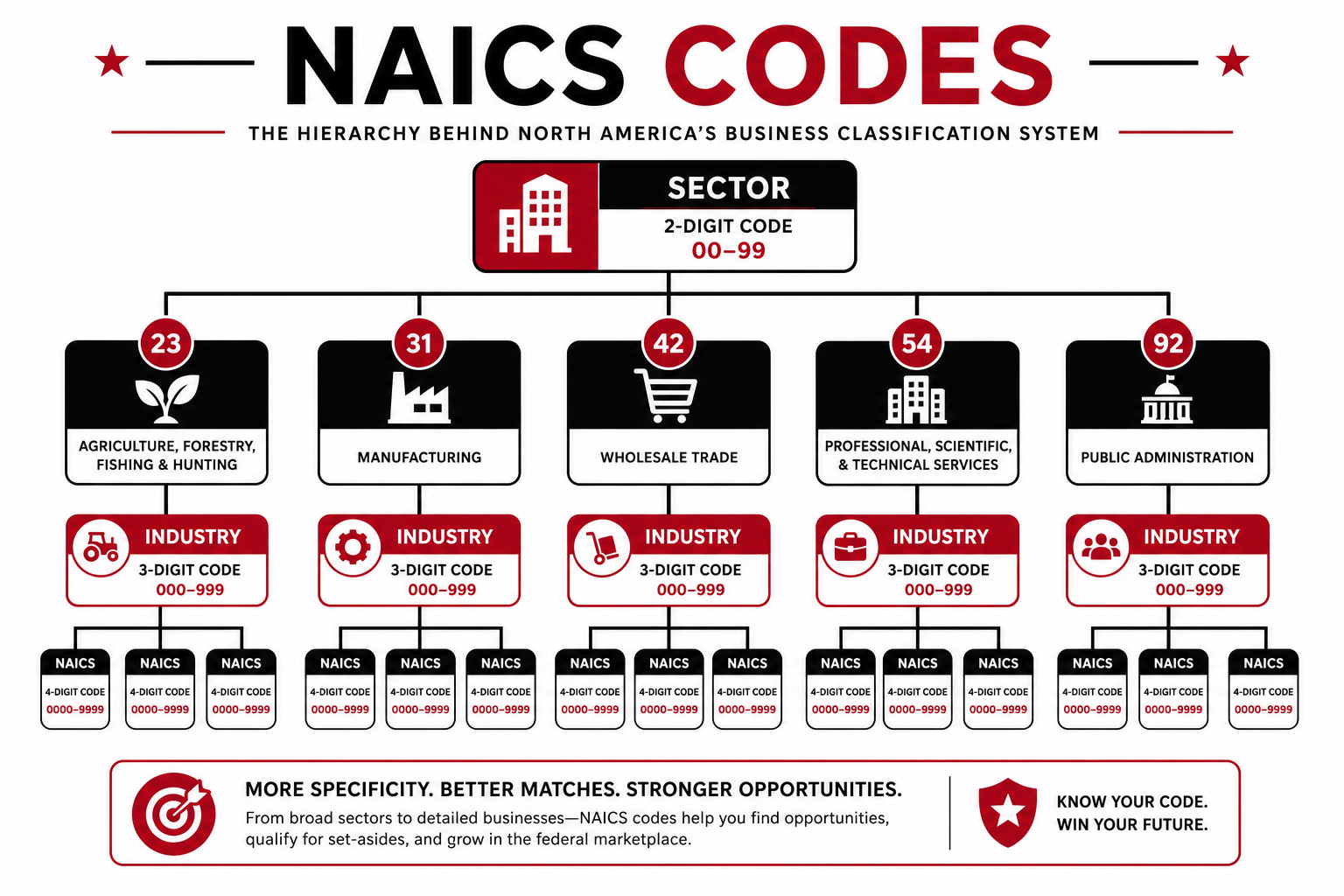
North American Industry Classification System codes define what you claim you can perform and which size standard applies to that work.
What it is
Every federal opportunity is tied to one or more NAICS codes. Your SAM profile lists the codes you claim. Size standards (employee count or average annual receipts) sit on those codes and drive small-business eligibility for set-asides. NAICS is how buyers, primes, and market research tools categorize you. If your codes are wrong or empty, you are invisible in the right lanes and visible in the wrong ones.
Why federal buyers care
If you are not under the right NAICS, or you claim codes you cannot perform, you waste everyone’s time. Set-aside eligibility, teaming conversations, and agency market research all lean on NAICS fit. A chase built on a fantasy code set burns BD hours and credibility.
How to get and maintain it
- List a clear primary NAICS plus secondary codes that match work you can actually deliver today.
- Map your top services and products to codes before you browse opportunities. Write the map down.
- Check the current size standard for each priority code. Growth can push you out of small status on a code you still market as small.
- Save SAM.gov searches filtered to your real codes and target agencies.
- Update SAM when your business model shifts into a new lane. Do not leave zombie codes that confuse buyers.
Common mistakes
- Listing every fashionable code hoping something sticks.
- Ignoring size standards until a CO asks for a size representation.
- Bidding work outside your honest NAICS story because “we can figure it out.”
- Never aligning capability statement NAICS with SAM NAICS.
List more than one NAICS, but do not invent a fantasy portfolio. Codes follow the work you can staff and deliver.
Rick Piña- Primary NAICS chosen and justified in writing
- At least 2 to 4 secondary codes that are real
- Size standard checked for each priority code
- Opportunity search filters saved against those codes
- Capability statement NAICS matches SAM
Capability statement
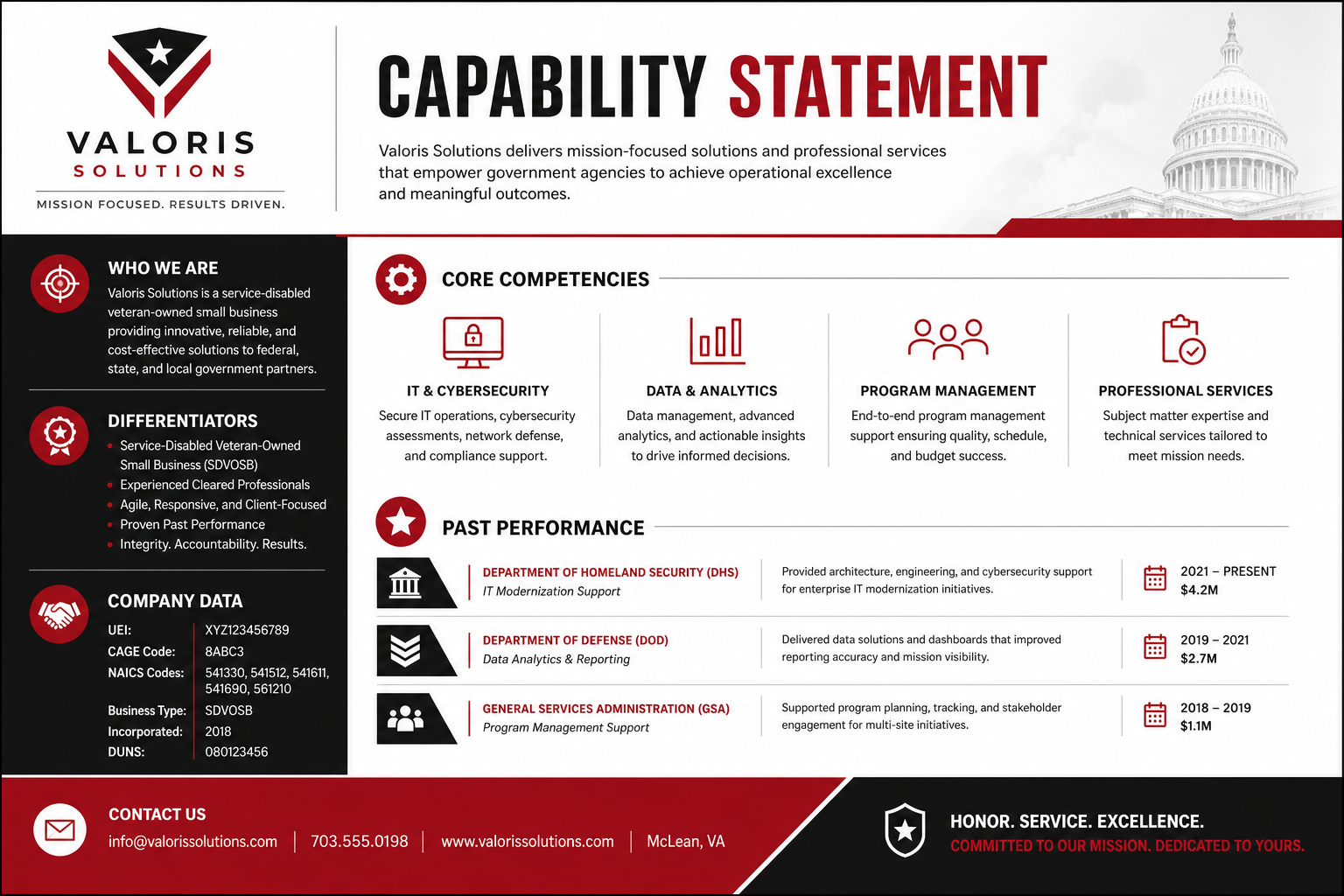
Your federal resume. Short, sharp, and built for a contracting officer’s attention span, not a brand poetry contest.
What it is
A one- or two-page PDF that states who you are, what you do, differentiators, core competencies, NAICS and related codes, past performance highlights, socioeconomic status, contract vehicles if any, and how to reach you. It is the leave-behind after every intro call and the attachment on every cold outreach, sources sought response, and teaming intro.
Why federal buyers care
Buyers and primes need a fast way to see if you belong in a market research response, a sources sought reply, or a teaming conversation. A messy brochure signals a messy delivery team. A clear capability statement gets you into the next conversation. A vague one gets filed and forgotten.
How to get and maintain it
- Lead with results and clear competencies. Open with what you deliver and for whom, not a slogan.
- Include UEI, CAGE if you have it, NAICS, approved certs, and a real POC with phone and email.
- Keep a master version. Create lane variants only when needed (for example staffing vs hardware vs cyber), and keep them consistent.
- Refresh after every meaningful win, teaming agreement, vehicle award, or cert change. Put a last-updated date in the footer.
- Export PDF. Test print. If it looks like a flyer designed for social media, rewrite for procurement.
Common mistakes
- Three pages of adjectives and zero proof points.
- Missing UEI, POC, or NAICS so the reader cannot act.
- Using an old cert claim after status changed.
- Sending a PowerPoint when the buyer asked for a one-pager.
If a stranger cannot tell what you sell in ten seconds, rewrite the capability statement.
Rick Piña- One to two pages, PDF, branded but clean
- Results-first competencies and differentiators
- UEI, NAICS, certs, and POC present
- Last updated date in the footer
- Lane variants (if any) still match the master facts

Past performance
Proof you deliver. If you do not have federal primes yet, start as a subcontractor and document like a professional.
What it is
Past performance is the government’s way of asking whether you have done something similar before, on time, on quality, and without drama. It shows up as CPARS ratings, questionnaires, customer letters, contract abstracts, detailed proposal write-ups, and reference calls. Commercial work can count when it is relevant and well documented, but federal-relevant references are the gold standard for federal pursuits.
Why federal buyers care
Technical scoring often weights past performance heavily. Weak or missing history is one of the fastest ways to lose to a less flashy but proven competitor. Buyers are buying reduced risk. Your record is how you sell that reduction.
How to get and maintain it
- Capture every relevant engagement: scope, value band, period of performance, customer POC, and outcomes.
- If you are new to federal, pursue subcontract roles under experienced primes. Negotiate visibility and a clean scope you can write up later.
- Ask for letters of recommendation and permission to use POCs while the work is fresh.
- Build a living past-performance library mapped to your NAICS, agencies, and offerings.
- Quantify outcomes where honest: schedule, quality, uptime, delivery accuracy, staffing fill rates, security posture, customer satisfaction.
Common mistakes
- Waiting for a perfect prime award before documenting anything.
- Writing vague “supported the mission” blurbs with no scope or outcome.
- Listing POCs who have moved or will not take a call.
- Stretching relevance so far the evaluator stops believing you.
Do not wait for a prime award to start your record. A clean subcontract with measured outcomes beats a blank page.
Rick Piña- At least 3 write-ups ready, or active subcontract pursuits if early stage
- Customer POCs confirmed and reachable
- Outcomes quantified where honest
- Relevance mapped to target NAICS and agencies
- Letters or questionnaires requested while memory is fresh
Small business certifications
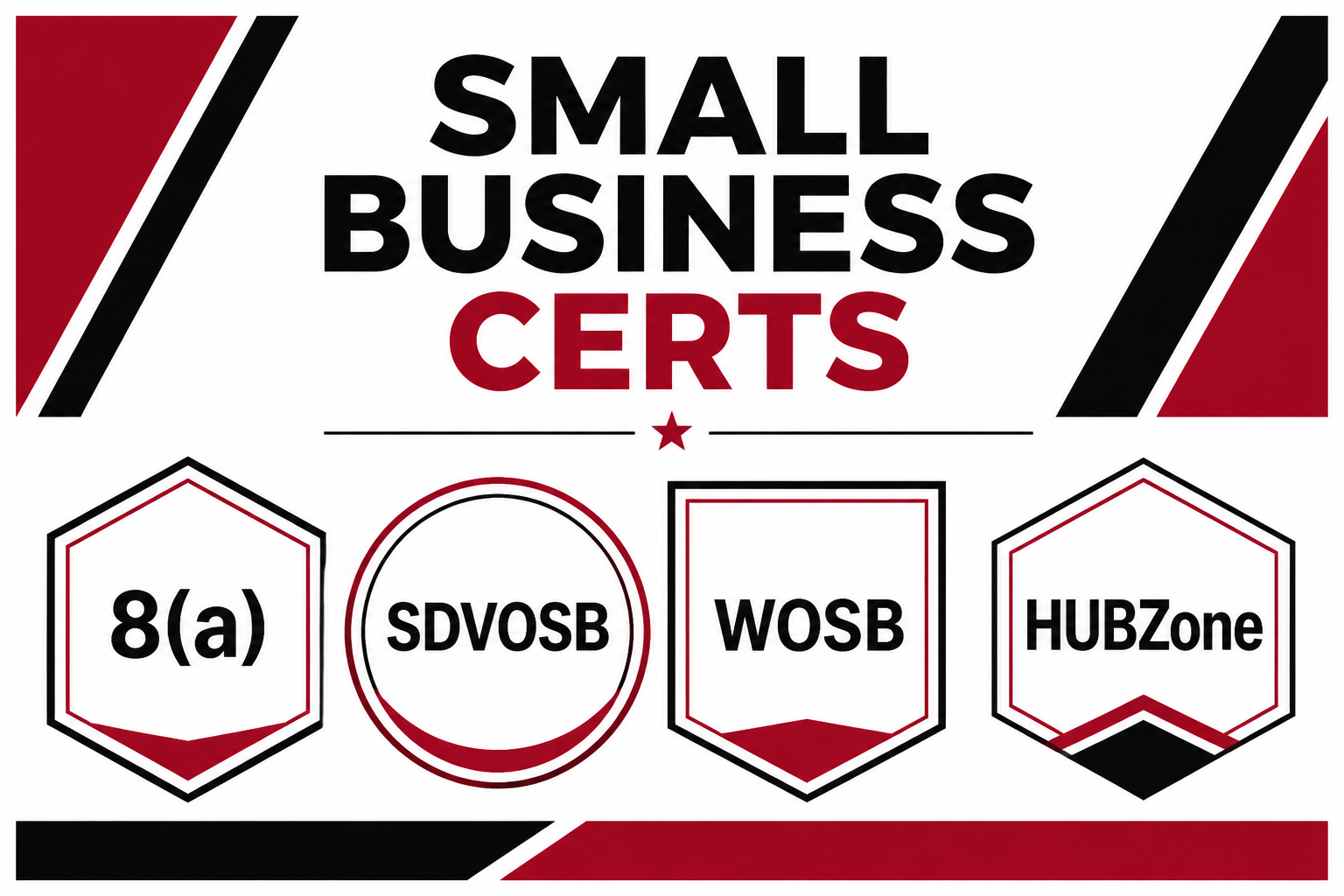
8(a), WOSB, HUBZone, SDVOSB, and related status when you truly qualify. Certs open doors. They do not replace readiness or delivery.
What it is
Socioeconomic and small-business certifications are administered largely through SBA processes, including MySBA Certifications, and related programs. Common lanes include 8(a) Business Development, Women-Owned Small Business, HUBZone, and Service-Disabled Veteran-Owned Small Business. Eligibility rests on ownership, control, size, and program-specific rules. Approved status should appear consistently in SAM, your capability statement, and your proposals.
Why federal buyers care
Agencies have goals and set-aside strategies. Your certs determine which lanes you can enter and how primes see you as a teammate. Fake, premature, or sloppy claims destroy trust and create legal exposure. The right cert, honestly held, is leverage. The wrong claim is a career problem.
How to get and maintain it
- Confirm eligibility in writing before you apply. Ownership, control, and size rules are real and fact-specific.
- Use official SBA / MySBA paths. Keep application evidence organized in a controlled folder.
- Track recertification and annual review dates the same way you track SAM renewal.
- Reflect only approved status in SAM, capability statements, websites, and proposals.
- Plan BD around the lanes your certs actually open. Do not collect logos for decoration.
Common mistakes
- Marketing “8(a) pending” as if it were awarded status.
- Ignoring control rules while assuming ownership percentage is enough.
- Missing recert deadlines and discovering it during a live bid.
- Thinking the cert replaces past performance, pricing discipline, or SAM hygiene.
The cert opens the door. Bid-ready documents and delivery keep you in the room. Never let the badge outrun the folder.
Rick Piña- Eligibility memo written (honest yes / no per program)
- Application or active status documented
- Recert and review dates on calendar
- Marketing claims match approved status only
- SAM and capability statement reflect the same status

W-9 & business license
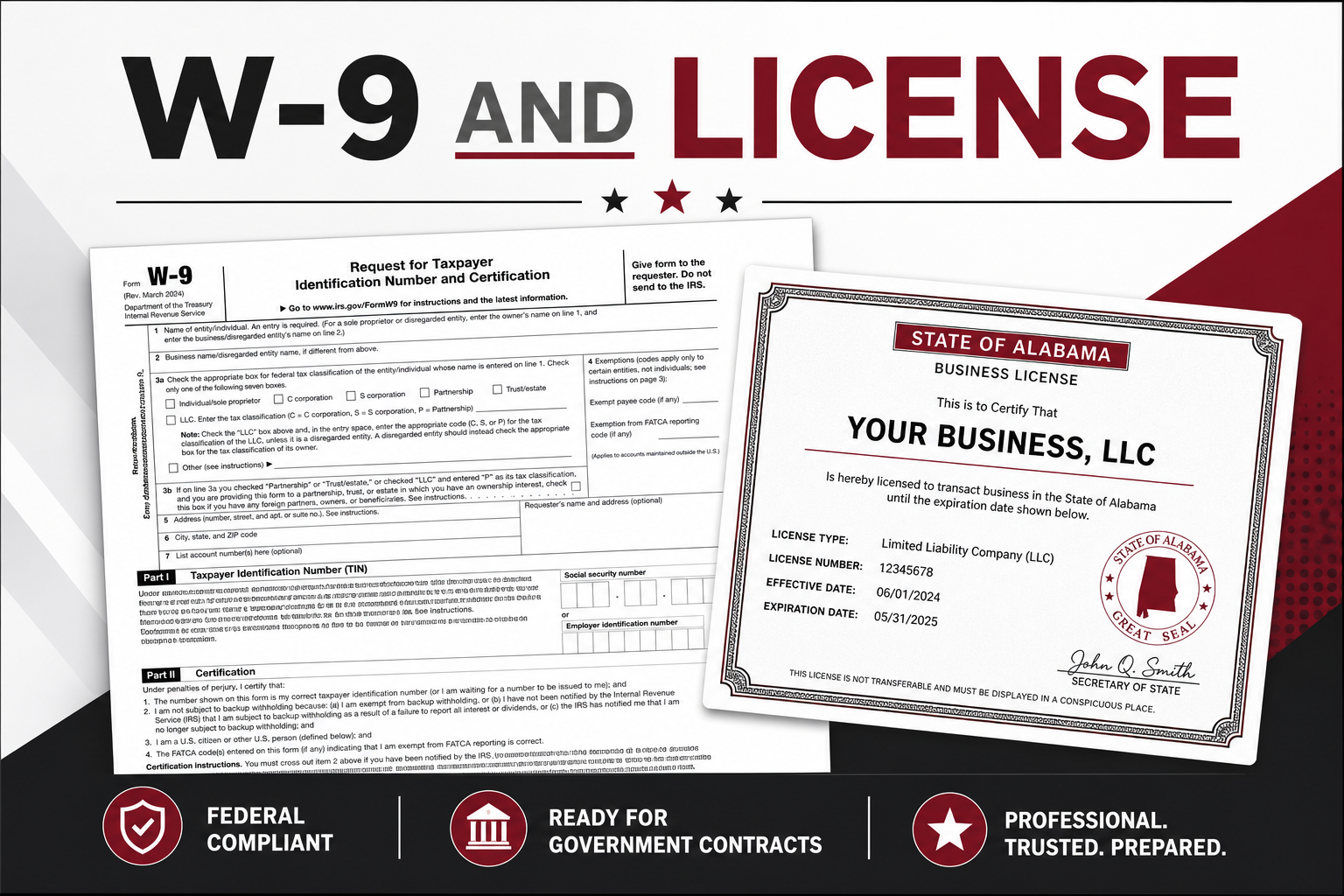
Basic corporate hygiene. These expire and change more than people check, and they stall onboarding when ignored.
What it is
IRS Form W-9 (or the entity tax information buyers and primes request) plus your active state and local business license and any required professional licenses for your trade. This is the paperwork primes and agencies need to set you up in their vendor systems, pay you, and satisfy compliance checks.
Why federal buyers care
Primes and agencies need clean tax ID data. Expired licenses create compliance flags. “We will send it later” often means “we will find another teammate.” Many pursuits die quietly in onboarding, not in technical scoring.
How to get and maintain it
- Keep a current signed W-9 PDF in your bid-ready folder.
- Renew business licenses before they expire. Store proof of active status with the renewal date logged.
- Update tax forms when entity name, address, or classification changes.
- Align legal name across W-9, SAM, bank, insurance, and proposals. One story everywhere.
- Be ready to share the packet to a prime within one business day.
Common mistakes
- Sending a W-9 with an old address or a nickname instead of the legal name.
- Discovering an expired city/county license during vendor setup.
- Having three slightly different legal name strings across systems.
- Keeping the only signed copy on someone’s laptop.
One legal name. One UEI. One tax ID story. Everywhere.
Rick Piña- Signed W-9 less than 12 months old, or refreshed on any change
- Business license active with renewal date logged
- Legal name matches SAM and bank records
- Insurance certificates available if primes require them
- Folder shareable to primes within one business day
Know where to look
Documents without a hunt plan are a museum. Competitors know where demand shows up and which vehicles their buyers already trust.
This guide does not pitch a third-party tool brand. Master the official sources and the lanes your buyers use. Then layer process discipline on top.
SAM.gov opportunities
Active solicitations, sources sought, pre-solicitations. Filter by NAICS, agency, set-aside, place of performance, and keywords you actually deliver. Save searches. Review them on a fixed cadence, not when you feel inspired.
Agency forecasts
Many agencies publish acquisition forecasts. Use them to shape teaming, hiring, and capability updates months early. Forecasts are imperfect. They are still better than surprise.
Recompetes
Incumbent work coming back to market. Study the old vehicle, performance gaps, transition risk, and whether you belong as prime or sub. Recompetes reward preparation more than heroics.
GSA / SEWP-style lanes
Contract vehicles and GWAC / IDIQ lanes matter. Learn which vehicles your buyers actually use before you invent a chase. Vehicle strategy without document readiness is theater.
Hunt where your NAICS, certs, and past performance already give you a right to win.
Rick Piña30-day bid-ready plan
Four weeks. Named owners. Visible dates. Move from “interested” to “folder ready.”
- Verify or complete SAM registration. Confirm UEI and Active status with a screenshot in the shared folder.
- Export reps and certs. Fix incomplete or inconsistent answers.
- Put renewal dates on a shared calendar. Name a primary owner and a backup.
- Resolve any legal-name mismatch between formation docs, SAM, and banking.
- Lock primary and secondary NAICS with honest size-standard checks written down.
- Draft or rewrite the capability statement. Results first. UEI, NAICS, certs, POC required.
- Align capability statement facts with SAM facts. No drift.
- Create the empty past-performance template you will fill in Week 3.
- Build at least three past-performance write-ups, or launch two serious subcontract conversations if you are early stage.
- Advance or verify SB cert applications and status in MySBA as eligible. Update marketing only for approved status.
- Refresh W-9. Confirm business license active. Log renewal dates.
- Assemble an onboarding packet primes can receive in one business day.
- Save SAM searches for your NAICS and target agencies. Put review on the calendar twice a week.
- Pull two agency forecasts. Mark three recompete watches with notes on prime vs sub fit.
- Identify the vehicles your buyers actually use. Decide which are worth a longer campaign.
- Run a red-team: can a stranger assemble your full bid-ready packet in five minutes without asking you questions?
Common failure modes
These are not style preferences. These are how competitors remove themselves from the game.
- Bidding with Expired SAM or a mismatched UEI
- Claiming NAICS or set-aside status you cannot support under scrutiny
- Capability statement that hides what you sell or omits how to reach you
- Zero past performance and zero subcontract plan
- Marketing certs you have not been approved for
- Stale W-9 or expired license when a prime asks for onboarding docs
- Chasing every solicitation instead of lanes you can actually perform
- One-person SAM admin with no backup and no calendar
- Proposal narrative that contradicts your SAM reps
Excited chase, empty folder
Founder spends days on pricing and win themes, then discovers SAM expired three weeks ago. The team scrambles. The deadline does not move.
Cert theater
Website shouts socioeconomic logos. Application is incomplete. A prime asks for proof. Trust collapses in one email thread.
Invisible relevance
Great delivery history sits in someone’s head. No write-ups. No POCs. Evaluators score what they can evidence, not what you remember.
Discussion questions
Which of the seven is weakest in your folder right now?
Name it. Put an owner and a date on the fix this week. Post the gap if you want accountability.
Are you building as a future prime, a strong sub, or both?
Your past-performance plan and vehicle strategy should match that answer. Do not pretend otherwise.
Which NAICS and agency lanes will you watch for the next 90 days?
Write three. Share one in the comments so we can sharpen fit and readiness together.
If a prime asked for your onboarding packet tomorrow morning, what would break?
That breakage list is your real backlog. Put it on the 30-day plan.
Get bid-ready. Then compete.
Federal contracting rewards preparation. Keep SAM alive, documents current, and the company story honest. Build the folder before chasing solicitations, from wherever your starting point is.
Download the PDF quick reference. Run the 30-day plan. Bring questions to the comments. Discuss this as competitors who help each other raise the standard.
Get the seven documents right. Know where to look. Then bid like you belong.
GET PDF
Printable letter booklet quick reference. Dedicated print layout. Nav and join CTA hidden in print.
COACHING & MENTORSHIP
Get coached by Rick & Isabella Piña.
If you are not a member of our Patreon, join today. Coaching and mentorship designed to maximize your potential, increase your personal productivity, and fulfill your life’s purpose. Weekly teaching, a private community, and one-on-one coaching calls, all on Patreon.
Hundreds of videos and weekly teaching on life, faith, family, business, and relationships. Private Grace Life Discord, early access, and bonus episodes.
Everything in Library, plus a monthly one-on-one phone call with Rick or Isabella (coaching, prayer, personal or business guidance) and direct Q&A access.
Monthly one-on-one video coaching sessions with Rick or Isabella, direct Q&A access, and the full content library.
Rick & Isabella Piña Coaching on Patreon · patreon.com/rickpina