The compliance gate after Session 5
Session 5 taught you to write a clean quote. This guide is the compliance gate before a formal or federal package goes out. Session 6 (Oct 19, 2026) goes deeper on legal and government contracting.
I did not write this guide to scare you off government work. I wrote it because a strong solution still dies if the package breaks the rules of the solicitation.
In this guide
One missed requirement can end a proposal
I saw a short LinkedIn post from GovCon Giants this week. One line stopped me cold: one missed requirement can end a proposal before anyone sees your solution.
That is true in federal work. It is also true in a simpler way when you send a quote to a customer who asked for three things and you only answered two.
Their six traps (credit THEM)
Here is what GovCon Giants named. Six traps only. I am not inventing a longer secret list for you.
Page limit
A page limit that gets exceeded.
Certification
A required certification left incomplete.
Mandatory req
A mandatory requirement nobody addressed.
Attachment
An attachment that never made it into the submission.
Amendment
An amendment that was not acknowledged.
Method / deadline
Wrong submission method or after the deadline.
Public LinkedIn spark on missed solicitation requirements. Their six traps are credited above. Not affiliated with or endorsed by GovCon Giants. View the post.
Evaluators eliminate first
Evaluators look for reasons to eliminate proposals. Your job is to give them zero reasons. That is not negativity. That is the price of admission.
In Luke 5:4, Jesus told Simon to let down the nets for a catch. In Session 5 I told you to lay down multiple nets. Today I want you to see the other side of that verse. A net that never fully goes into the water does not catch. The same is true of a proposal that never fully answers the instructions. Strong technical story. Wrong format. Missed shall. Late portal. The catch never happens.
- Solicitation
- The buyer’s written instructions.
- Compliance matrix
- Requirement / our answer / where it lives in the package.
- Amendment
- A change to those instructions after release.
- Shall
- A mandatory must-do in the statement of work.
Operator process, not invented battlefield tales
At Inspired we got tired of hoping the writers remembered every instruction. So we built a final check.
Fresh eyes. Fresh extraction of requirements. Then a hard look at page limits, forms, signatures, amendments, method, and the deadline with the timezone written out. The verdict has to land in the first sentence: SUBMIT, FIX FIRST, or DO NOT SUBMIT.
Why fresh eyes: a matrix built while drafting can carry the writers’ blind spots. We do not trust the matrix we built while we were drafting.
We also fill the compliance matrix. If the RFP asks for one, we fill it. If it does not ask for one, we still build our own so every shall has a home in the package. A MET with no page citation is not a MET.
- SUBMIT = zero MISSING, zero kill shots, no deficiency-level findings
- FIX FIRST = fixable findings exist
- DO NOT SUBMIT = missing mandatory, blown page limit, unacknowledged amendment, or anything that gets the package thrown out unread
Proof artifact (no win/loss claim)
We have used that matrix shape on real work, including a Statement of Objectives (SOO) matrix with our partner LVSI for a McConnell Air Force Base ballroom A/V refresh (RFQ #1772815). Columns were simple: SOO requirement, our solution, proven capability. Simple is the point. Every row gets an answer.
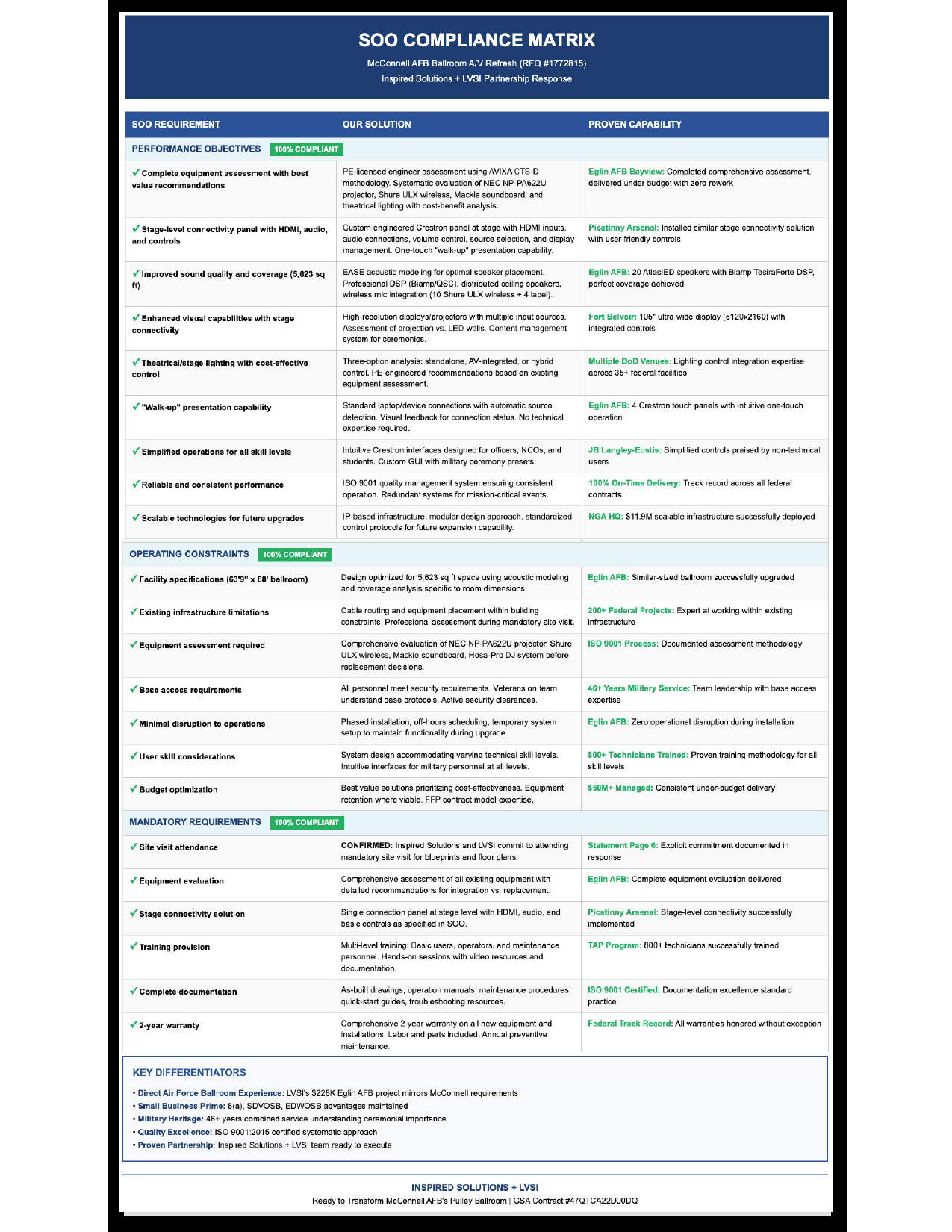
Phase 9 submission prep texture
- SF 1449 and SF 30 acknowledgments when instructed
- FAR 52.212-3 reps and certs when required
- Wet-ink signature schedule (at Inspired, Isabella signs SF 1449 Block 30a when that form is used)
- Staged SUBMIT_THIS_PACKAGE folder mindset
- Named person who presses submit
After a loss
Request a debrief. Sourced learning gap: our GSA desk had to own a stretch where we had zero debriefs on file as of mid-2026. Silence taught us nothing. I want you to learn faster than that.
Label every row before you check it
Print the full checklist from the PDF. Check boxes in pen. Someone named signs the bottom before submit. Below is the lane map and a summary. The printable checkboxes live in the letter PDF.
Download printable checklist (PDF)
Use on one-page quotes, text-message quotes, and simple proposals
Not the same as a federal Section L check. Session 5 one-liner: Say the price. Write it down. Follow up. Get paid.
- Their situation is first (not my bio)
- Solution is clear in plain English
- Total cost is a real number (not “pricing available upon request”)
- What is included and excluded is written
- Deposit / payment terms when the work is custom
- Timeline and quote expiration date are written
- Why they should pick me is provable (no invented reviews)
- I can defend every line out loud before I send
- Follow-back date is on my calendar
- If a fact is missing, I wrote Need input (I did not invent)
- AI may have drafted. I read it. I approve it. It goes out under my name.
Map: GovCon Giants six traps to Inspired final-check spine
Use when there are written instructions, volumes, forms, portals, or amendments.
- B1 Page limit (GCG trap 1): re-read Section L / RFQ instructions; actual FINAL page count at or under limit; fonts, margins, naming match when specified
- B2 Required forms (GCG trap 2): every required form in the package; reps and certs current; signatures present; wet-ink schedule confirmed when required
- B3 Mandatory requirement (GCG trap 3): compliance matrix exists; every shall marked MET / PARTIAL / MISSING; every MET has a citation; MISSING on punch list before submit
- B4 Attachments (GCG trap 4): final file list matches instructions; SUBMIT_THIS_PACKAGE staged; price in narrative matches cost workbook to the penny
- B5 Amendments (GCG trap 5): all amendments in folder (or confirmed none); Q&A read; acknowledgments queued; narrative reflects latest amendment
- B6 Method and deadline (GCG trap 6): method matches instructions; deadline date + time + timezone on the sheet; named submitter written; tracking plan after submit
Do this AFTER writing is done
- Fresh re-read of the solicitation set from scratch (not from memory)
- Requirements inventory rebuilt from source docs
- Mechanical kill-shot sweep complete
- Evaluator-seat read complete (shall answered with will, no placeholders, no TBDs)
- Verdict in the first line: SUBMIT / FIX FIRST / DO NOT SUBMIT
- If FIX FIRST or DO NOT SUBMIT, punch list ranked with the specific fix
- Gold Team / owner approval before ship
Silence teaches nothing
- Loss notice saved in the opportunity folder
- Debrief request drafted the same day
- Final Check memo reviewed against what the government said
- One process change written down so the same miss does not repeat
Session 5 behind you. Session 6 ahead.
Session 5 of the Victory Entrepreneurship Consortium taught you how to write a clean quote. Six blocks. Real total. Timeline. Expiration. Defend every line. This guide is the next gate.
Sales, Proposals and Winning Business
VEC Year-2 Session 5 · Rick and Isabella Piña
Open on YouTube (youtu.be/qr4x3kwFTLI)Session 5 class page (video, notes, handouts): guides.rickpina.cloud/vec/2026-month-5/
Next: Session 6 Legal + Government Contracting, Monday, October 19, 2026, 7:00 to 9:00 PM ET. Put that date on your calendar.
Work the checklist. Then come ready for Session 6.
I did not write this guide to scare you off government work. I wrote it because a strong solution still dies if the package breaks the rules of the solicitation.
At Inspired we got tired of hoping the writers remembered every instruction. So we built a final check. Fresh eyes. Fresh extraction of requirements. Then a hard look at page limits, forms, signatures, amendments, method, and the deadline with the timezone written out. The verdict has to land in the first sentence: SUBMIT, FIX FIRST, or DO NOT SUBMIT.
We also fill the compliance matrix. If the RFP asks for one, we fill it. If it does not ask for one, we still build our own so every shall has a home in the package. A MET with no page citation is not a MET.
I am not going to invent a war story for you about a proposal we lost on a missed amendment. What I will tell you is process. We named unacknowledged amendments as a classic kill shot in our own protocol for a reason. We stage a SUBMIT_THIS_PACKAGE folder for a reason. Isabella signs wet-ink when the form requires it for a reason. Someone named presses submit for a reason.
On the commercial side, Session 5 still stands. Say the price. Write it down. Follow up. Get paid. Do not send a quote you cannot defend line by line. Write Need input instead of inventing.
If you lose, ask for the debrief. Our GSA desk had to own a stretch where we had zero debriefs on file. Silence taught us nothing. I want you to learn faster than that.
Work the checklist. Then come to Session 6 ready to talk legal and government contracting with eyes open.
- Print the pre-submit checklist from the PDF.
- Label which rows are every quote vs solicitation / govcon.
- Run the commercial half on one live quote you already sent or need to send.
- If you touch federal instructions this month, build a one-page compliance matrix before you write a single paragraph of solution.
- Put Session 6 on your calendar: Legal + Government Contracting, Monday, October 19, 2026, 7:00 to 9:00 PM ET.
- Which of the six traps have you seen (or almost made) in your own work?
- What is one commercial quote rule from Session 5 you still skip under pressure?
- If you lost a bid recently, did you ask for a debrief? If not, what is stopping you?
Open the guide. Download the PDF. Work the checklist before your next quote or proposal leaves the building.