Recording
Original organizer promotion
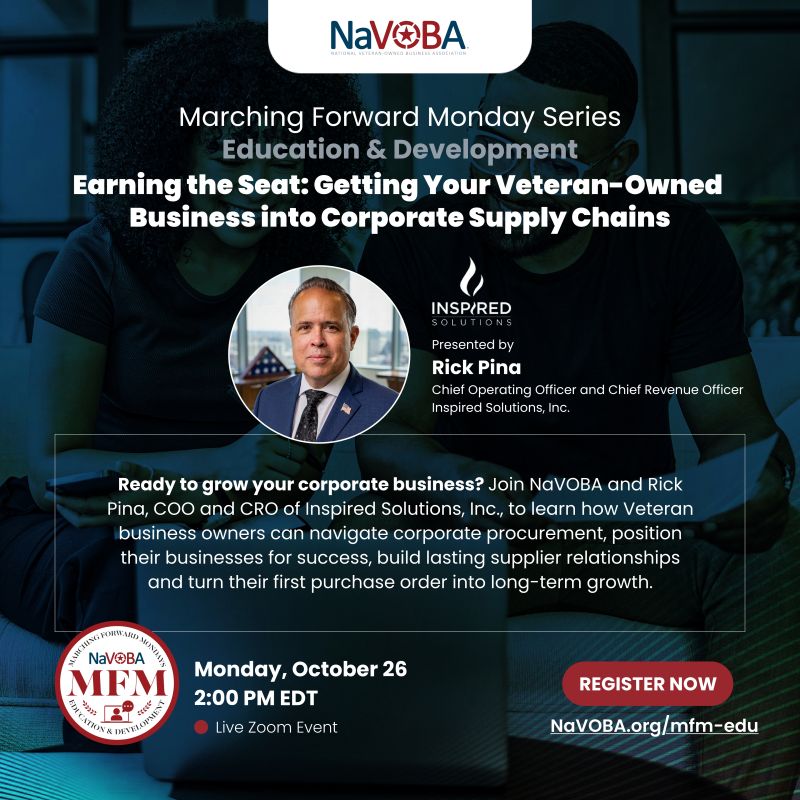
Guide and class Q&A
Rick Piña NaVOBA Marching Forward Mondays, Education & Development Live virtual class, October 26, 2026
How to use this guide
This is the full study guide for the class I taught for NaVOBA, the National Veteran-Owned Business Association. NaVOBA certifies veteran-owned businesses for corporate supply chains and runs the Marching Forward Mondays education series.
The guide follows the class in order. Five phases. The questions attendees asked. Then a workbook so you can do the work, not just read about it.
Look for the "Fictional worked example" boxes. These are made-up businesses and made-up numbers so you can see the math. They are not customers, not my company, and not results anybody achieved.
This guide is not legal, tax, financial, or cybersecurity advice. Talk to a qualified adviser before you sign, borrow, or certify anything. This guide is not an official NaVOBA publication.
Why I taught this
I served in the U.S. Army for 25 years. I joined enlisted, went E1 through E6, became a warrant officer, and retired as a chief warrant officer five. My wife Isabella started enlisted too. The Army sent her to school through the Army Enlisted Commissioning Program, and she became an Army nurse and retired as a major. We retired on the same day, at the same ceremony.
After the Army I went to Worldwide Technology, a large integrator. Isabella founded our company, Inspired Solutions. A few years later I left to come help her, and we have been growing this business ever since.
So I have sat on more than one side of this table. I was inside the Army when it bought technology. I was at a large integrator that sold to the military, federal agencies, states, and universities. And now I am at a small veteran-owned business trying to get in the door just like you.
Here is the problem I see over and over. You get certified. You register. You send somebody a capability statement (a short document that says who you are, what you do, and who you have done it for). You talk to somebody at a booth. And then you wait. That response may or may not come.
The certifications are great. We have a bunch of them. But having a certification does not mean it is going to lead to business directly. A certification may start a conversation. The customer is not buying a certification. They are trying to get an answer to their problem.
So this class answers a few questions. Who should you be talking to? How do you get in? And if you actually win a contract, how do you deliver with excellence?
Where do you actually stall?
Before you read further, name where your business gets stuck. Different stalls need different moves.
- Getting noticed. Nobody answers. Start with Phase 1 and Phase 3.
- Finding the person who owns the need. You meet people, but never the right one. Start with Phase 2.
- Passing onboarding. You get interest, then the paperwork stops you. Start with Phase 4.
- Carrying the work. You can win it, but you cannot fund it. Start with Phase 4.
- Growing after the first order. You got in once and it never grew. Start with Phase 5.
A word list before we start: military language to business language
Every arena has a language. When I was a Signal officer, the Signal officers who did well were the ones who understood the language of the combat arms officers. The Army is mostly run by infantry and armor officers. If you could not speak their language, you were not really welcomed into that environment.
It is the same thing in business. Business has a language. You understand the commander's intent. In business that could be the corporate strategy. You understand the mission. In business that could be the business outcome. You have to think in their language and speak their language.
When you first start, of course, it is all new. Over time you learn it. If I am speaking my customer's language, they are going to be more apt to do business with me.
Here are the terms you will see in this guide, in plain English.
| Term | Plain English |
|---|---|
| Commander's intent | In business: the strategy. What leadership is trying to achieve and why. |
| Mission accomplished | In business: the business outcome. The result the customer actually cares about. |
| KPI (key performance indicator) | A number a team tracks to show whether it is winning. |
| MSA (master services agreement) | The umbrella contract that sets the general terms for future work. |
| SOW (statement of work) | The document that describes one specific job: tasks, deliverables, schedule. |
| Net 15, Net 30, Net 60, Net 90 | Payment terms. The customer pays a set number of days after an invoice is accepted. Net 60 means about 60 days. |
| SLA (service level agreement) | The promised performance standard, such as uptime or response time. |
| QBR (quarterly business review) | A quarterly meeting where you show the customer what you delivered and what is next. |
| TCO (total cost of ownership) | Everything a purchase costs over its life, not just the sticker price. |
| G&A (general and administrative) | Company costs that keep the whole business running, such as accounting, legal, and leadership. |
| Overhead | Costs that support delivery but are not billed to one job, such as facilities and support staff. |
| Fringe | The cost of an employee beyond salary: benefits, payroll taxes, retirement match. |
| Capability statement | A short document that says who you are, what you do, and proof you have done it. |
| Past performance | Proof you have done this kind of work before, with whom, and when. |
| RFI (request for information) | A buyer asking the market for information before it buys. |
| Sources sought | A government notice asking which businesses can do a job, often used to decide whether to set it aside for small business. |
| Supplier diversity office | The corporate team that helps the company find and use diverse suppliers, including veteran-owned businesses. Some companies use other names for it. |
| Small business office | The government version. Most federal agencies call it the OSDBU (Office of Small and Disadvantaged Business Utilization). |
| Procurement | The team that qualifies suppliers, negotiates, and puts them under contract. |
| Business owner (inside a company) | Not the founder. The leader of a business unit who owns the problem and the budget. |
| Prime | The company that holds the contract directly with the customer. |
| Sub, or Tier 2 supplier | A company that works under the prime. You invoice the prime. The prime invoices the customer. |
| Contracting officer | The government official who can legally commit the government to a contract, within the authority they have been delegated. |
| PM and PMO (program manager, program management office) | The government leader and office responsible for a program and its mission. |
| CRM (customer relationship management) | Software or a system to track leads, contacts, and next steps. |
| NDA (non-disclosure agreement) | An agreement to protect shared information. Usually the first document you sign. |
| Teaming agreement | An agreement between companies that plan to pursue or perform work together. |
| Certificate of insurance | The document that proves you carry the insurance a buyer requires. |
| NIST and CMMC | Federal cybersecurity standards (NIST) and the Defense Department's certification program for them (CMMC). They apply when a specific contract requires them. |
| VBE and SDVBE (NaVOBA certification) | Veteran's Business Enterprise and Service-Disabled Veteran's Business Enterprise. Private-sector certifications corporations use. |
| VOSB and SDVOSB (SBA VetCert) | Veteran-Owned and Service-Disabled Veteran-Owned Small Business. Federal certifications from the U.S. Small Business Administration. Different program, different rules. |
One distinction matters a lot. NaVOBA certification is a private-sector certification for corporate supply chains. SBA VetCert is the federal certification for government set-asides. They are not the same and one does not replace the other. The research appendix has the details.
Phase 1: Recon. Choose the buyer and understand the problem
Let me start with a military word. Initially, you have the reconnaissance phase. Who do I want to sell to? Who do I want my customer to be?
A lot of times we start out saying, "Hey, I'll sell to anybody who wants to work with me." But you have to think through that. Who is the optimal customer for you? And then what is it that they actually do?
Once you know who that is, how do you get to them? Do they have a small business office? Do they have a supplier diversity program? Do they have somebody who has publicly stated that they want to support veteran-owned small businesses? Who are these people, and how are you going to get to them?
And when you get there, saying "I'm a veteran and I have a business" is not enough. What are you going to offer them? What is the solution?
Here is what that looks like at a conference. Let's say I walk up to the supplier diversity booth of a big company I have never researched. I say, "I would love an opportunity." Well, that is probably what everybody says. Have I done any research? No. So that conversation is going to be weird.
Now flip it. I walk up to a company I have actually studied. They have published their top priorities. Their leaders have stated their intent for next year. And I have something that could be of value to them. That is a completely different conversation. Now I can say, "I read this. I saw that your CEO recently said this. You published this on your website. Your top three priorities are these, and I can help you with two of those three. Here is how."
The Army strategy story
Let me flip the script for a minute. When I was the Chief Technology Officer for the Army, I worked directly for the CIO. My boss asked me to help lay out something we called the Army Network Campaign Plan. It took about 14 months to write it and socialize it throughout the Pentagon. We published it. We talked about it in every forum.
Before we published that plan, companies could come in and tell us what they had and what they sold. After we published it, things changed. If a company could not tell me they had read the plan, I noticed. If they could not show me how their solution lined up with one of our lines of effort, they were basically telling me they did not prepare.
So if your customer has something published, and they have a strategy and have communicated it, you should prepare. You are not just a general vendor. You came with a solution to one of their stated problems. That proves you did your homework.
What the buyer is silently thinking
In government we call the buyers acquisition professionals. In a lot of corporate companies they are the buyer team, the supplier diversity team, or the procurement team. Whatever the title, if they carry this responsibility, they are thinking about three things.
Cost. You are a small business. Is it going to cost me more? Maybe a bigger company can get it cheaper. Or maybe you have less overhead on services and can do it for less. Either way, you have to be able to communicate whether you will save them money.
Risk. In our case we do services and logistics, and we also sell IT products. If a customer buys the same router or the same storage appliance from us or from a huge company, it is the same technology, same software, same warranty. So the product risk is a little lower. But there is still a different kind of risk because we are a small business. Can we hit that number? If they give us a large order, do we have the credit to carry it? You have to be able to answer that.
Results. When I worked with acquisition professionals in the military, they were ultimately buying for the units and the warfighter. They needed to know the warfighter would be happy with what they bought. It is the same in a company. Procurement is buying for the people who actually execute the mission. If those people are not happy with what you provide, you are going to have a problem.
Common failure and the better approach
- Common failure: you treat the supplier diversity booth as the customer and pitch your certification.
- Better approach: you treat the end user as the customer, you know their published priorities, and you show how you reduce their cost, their risk, or improve their results.
Fictional worked example: Recon done two ways
Fictional business: Ridgeline Field Services, a made-up veteran-owned facilities maintenance company. Fictional buyer: a made-up regional hospital network.
The weak version: Ridgeline's owner walks up at a conference and says, "We are a certified veteran-owned business and we would love an opportunity."
The prepared version: Before the conference, the owner reads the hospital network's public annual report. It says the network is opening two new outpatient clinics next year and wants to reduce maintenance downtime. The owner writes down three priorities, picks the one Ridgeline can actually help with, and walks up ready to say: "I read that you are opening two clinics next year. We maintain HVAC and backup power for small medical sites. I would like 15 minutes to show you how we schedule preventive maintenance so a clinic does not go down."
Nothing in that example is a real company or a real result. The point is the order of the conversation: their priority first, your fit second, a small ask last.
Reflection questions
- Who is the optimal customer for your business, and why them and not "anybody"?
- What has that customer published about its priorities in the last 12 months?
- Who inside that customer actually uses what you sell?
- Which of the three silent concerns (cost, risk, results) is your weakest answer today?
Workbook: Worksheet 1, Target Research.
Phase 1, continued: Know their numbers and know yours
When you finally get in front of the company or the agency, you should be able to say, "I read your stuff. I understand your priorities."
We had to do the same thing in the Army. When we went down the hall to brief senior Army leaders, we had to make sure we were lining up with their top priorities. We had to communicate how we were supporting their priorities. It is the same thing with a company. You need to understand what they are trying to do and how you support it.
For example, say you get in front of a supplier diversity officer. They may have a stated goal to do a certain share of their business with veteran-owned, minority-owned, or women-owned businesses. Now you can say, "You have this goal. I am one of those businesses. I read your priorities, and I think I have something that can support you. Here is how."
Then the other half. I need to know their numbers. I also need to know my numbers. If I am telling them how I can help them meet their goals, that is great. But if I get a contract, I better know my numbers too.
The pricing lesson I learned the hard way
When my wife first started the company, she won a services contract. I was still working at Worldwide Technology. She had to figure out how much to charge for a person. Somebody told her, "Take whatever their salary is and add 30% to it. That should be enough to make a profit."
Well, there are so many variables that go into that. If you have a services business, you have the cost of the person, which is their salary. Then you have G&A, overhead, fringe, and profit. You have to cover G&A, overhead, and fringe before you ever get to profit. If you do not know what those numbers are, look them up.
I will use round numbers. Say I win a contract to provide an engineer, and I pay that engineer $100,000 a year. Great. But our company also provides benefits, a retirement match, a computer, company shirts, an email address. All of that costs money. So we have to know what that person actually costs us, and then how much profit we can make.
Somebody asked earlier, "What if I don't sell a product? I provide a service." Then you need to know what that service costs. It is cool if you are going to do all the work yourself. But eventually, to run a business, you cannot do all the work. When you hire somebody, how much does that person cost? What are you charging for that person? Do you know your numbers, not just their numbers?
If you do not make a profit, you can win a bunch of business and lose money. Unfortunately, that happens to small businesses every day.
Keep this in mind
The $100,000 salary above is a round-number illustration from the class. It is not a staffing rate, a recommended salary, or a prescribed markup. Your rates depend on your market, your contract type, and your accounting. Have a qualified accountant check your model.
Two words people mix up:
- Markup is profit as a percent of cost. Cost $100, price $110, markup 10%.
- Margin is profit as a percent of price. Cost $100, price $110, margin about 9.1%.
Fictional worked example: "Salary plus 30%" versus a full cost build
Fictional business: Harbor Point Analytics, a made-up veteran-owned data services firm. Every number below is invented for teaching.
The full cost build for one analyst for one year:
- Salary: $80,000
- Fringe (benefits, payroll taxes, retirement match), assumed at 28% of salary: $22,400
- Role-specific direct costs (laptop, software licenses, training): $4,000
- Share of company overhead assigned to this role: $12,000
- Subtotal before G&A: $118,400
- G&A, assumed at 10% of that subtotal: $11,840
- Total annual cost: $130,240
Billable hours:
- Available hours in a year, assumed: 1,880
- Utilization (the share of hours you can actually bill), assumed 85%: 1,598 billable hours
- Cost per billable hour: $130,240 divided by 1,598 = about $81.50
Price with a 10% margin target:
- $81.50 divided by 0.90 = about $90.56 per hour
Now the shortcut:
- Salary plus 30%: $80,000 times 1.30 = $104,000 a year
- Divided by 1,598 billable hours = about $65.08 per hour
Harbor Point's shortcut price is about $16.42 an hour below its own cost. Over a full year on one analyst, that gap is $130,240 minus $104,000 = $26,240 lost. Win ten of those seats and the loss is ten times bigger.
Your percentages will be different. The lesson is the structure: cost first, then profit.
Reflection questions
- Do you know your fully loaded cost for one person, one hour, or one unit?
- What utilization are you assuming, and is it realistic?
- Can you explain your price in the buyer's language (cost, risk, results)?
Workbook: Worksheet 4, Services Economics.
Phase 2: Find the right door. Four doors, four different jobs
Let's talk about who to talk to. This was one of the first questions in the class. Who is the right person?
There are four doors. The supplier diversity officer. The business owner inside the company. The procurement team. And a prime supplier that is already there. You have to know how to communicate to each of these people.
Door one: supplier diversity, or the small business office. Now that I am talking to them, do I know their goals? What share of spend do they want to go to veteran-owned, service-disabled veteran-owned, or women-owned businesses? How can I help them with that? They can be a great introduction. They are not an automatic contract.
Door two: the business owner. I do not mean the owner of the company. I mean the business owner within the corporation. A large company has different business units, and there are business owners in every one of those. Each unit can need something different. Those are different conversations. I need to be ready to talk to that business owner about what they do and how I could provide value. Those are the people who actually have the budget.
Door three: procurement. Maybe I talk to the procurement team that buys for all those business units. That is great. But I have to give them the information in a way that helps them be successful when they go talk to the business owners. Help procurement explain your value to the people who own the need, and respect their process.
Door four: a prime supplier. Say I get the opportunity to talk to a large company that already has a contract with an agency or organization. That customer may expect the prime to use small businesses on that contract. The prime is already there. That could be an easy button. But now you have to prove you can provide value and help them, without slowing down progress while they are already working with their customer.
The same doors in government
On the government side the doors have different names.
- Supplier diversity at a company is the office of small business at an agency.
- Procurement at a company is the contracting officer, the contracting office, or the acquisition team at an agency.
- The business owner at a company is the program manager at an agency. The PM for a specific system or program. The program manager owns the need and the mission. The program manager does not award the contract.
- A prime supplier at a company is a large prime on the government side.
- A company might say, "Go to our supplier portal." The government says, "Go to SAM.gov."
Do contracting officers matter? Yes
One attendee asked if contracting officers are worth knowing, since they are not the final users. I said yes and no. Do not write them off.
I used to be the customer. I would see something and say, "This is amazing. We should buy this thing." That does not mean we were going to buy it. We gave it to the acquisition team, and once it was with acquisition, the customer legally had to stay out of the way. The acquisition team might ask a technical person to sit on a source selection board and read proposals to make sure they made technical sense. I did that too. But I did not get to make that decision. The contracting officer gets to make the call on how the government spends the money. They are the ones who legally have that authority.
How do you find them? A lot of times they host sessions. In my area, an Air Force small business office holds seminars and outreach sessions. Sometimes I drive over and sit down with them face to face and ask, "What are your requirements?" Sometimes they connect me with the unit that has the need. Then I go learn about that requirement and build that relationship too. The contracting office may have goals for small business, and the unit has a mission. I want to respect both. Contracting officers have a lot more power than some people think.
Keep this in mind
A contracting officer can bind the government only within the authority delegated to them. Program staff and technical evaluators have defined roles. Enthusiasm from a user is not a contract. A relationship is not an award. When a procurement is active, follow the communication rules in that solicitation. Use outreach events and industry days to learn the requirement and the legitimate next step. Never try to go around the process.
Fictional worked example: one target, four doors
Fictional target: a made-up regional grocery chain. Fictional supplier: a made-up veteran-owned refrigeration repair firm.
- Door one: the chain's supplier diversity manager, found on the company website and met at a NaVOBA event. Ask: "Which business unit owns store equipment maintenance?"
- Door two: the director of store facilities. Owns the problem: freezer failures that cost product. Owns the budget.
- Door three: the procurement category manager for facilities services. Needs your insurance, financials, and references to set you up.
- Door four: the national maintenance company that already holds the chain's facilities contract. Might need a local subcontractor in your region.
Each door gets a different conversation. The diversity manager hears how you help their goals. The facilities director hears how you cut freezer downtime. Procurement hears that you are ready to onboard. The prime hears that you can cover a region without slowing them down.
Reflection questions
- For your top target, can you name a person or role at each of the four doors?
- Which door have you been knocking on over and over? Which have you ignored?
- Are you mixing up your corporate map and your federal map?
Workbook: Worksheet 2, Four-Door Map.
Phase 3: Prepare. The partner route, the warm introduction, and problem, proof, number
Take the sub role
If somebody else has the prime relationship and you can get in as a sub, get in. We do a lot of work with larger companies where we are the sub. I am cool with that. If you come in as a sub and do a really good job, the customer may notice. Later, the customer may bring you in as a prime. Or not. Either way, a lot of these are Tier 2 relationships. I will take Tier 2 as long as I am able to transact business and add value. I will do it through a prime. I will do it as a sub. I will do it as a prime myself. I am not going to turn that down.
Warm before cold
Everything is relationship based. You can ask people you know for an introduction. You can ask organizations like NaVOBA for help. You can ask a prime. Of course, you can just cold email somebody or walk up to somebody. You can do that too. But that is the hardest one. If I am one degree away from somebody and I can get someone to introduce me, that is the best case scenario.
Once you get the introduction, be ready
Once I get that intro, I better be ready to have that conversation. I am going to lead with the problem I heard them state, or the problem they published. They are trying to implement AI. They are trying to get a hold of their supply chain. They are trying to get visibility on something. Whatever it is, I identify that first.
Then I show past performance. I have done this before. Put it on your capability statement: here is where we did it, for which company, agency, or organization.
Then numbers. Show a measured result. If you took a process that used to take a long time and made it much faster, that is a cost savings for your customer. Now you can talk about that.
You cannot just walk up and say, "Hey, I'm a veteran-owned business." The certification is fine. But your conversation needs to be about their mission and what you are solving for them. If you send an email or a message, do not start with your certification.
Lead with something like this. "I was at this conference. You did a great job on your keynote. I heard you say you are trying to solve this problem. My company can do that. Can I get 15 minutes?"
Now they are thinking, "This person listened to me. This person understood what I said. This person took notes. They have something, and they are only asking for 15 minutes." That is an easy yes. Get with my assistant. Get on my calendar.
But if I just email them and say, "Hey, I'm a veteran," how many of those emails are they going to get? A lot.
Problem, proof, number
- Problem: the buyer's problem, in their words, from a source you can point to.
- Proof: where you already solved something like it, and how recently.
- Number: what changed. Days, dollars, hours, or percent, with the starting point.
- Ask: one small, specific next step. Fifteen minutes is a good ask.
- Certification: mention it last, as support, not as the pitch.
Keep this in mind
Use only real past performance the customer agreed you can share, and real measured results. If you do not have a result yet, do not make one up. Use the closest true proof you have: a smaller customer, a government job, a local job, or a pilot. Never put a customer's name or logo in your materials without permission. A great opener does not guarantee a meeting.
Fictional worked example: rewriting the opener
Fictional business: Cedar Line Logistics, a made-up veteran-owned last-mile delivery company. Fictional buyer: a made-up medical supply distributor whose COO said in a public interview that late deliveries to clinics are their top complaint.
Before: "We are a certified veteran-owned business and we would love the opportunity to work with you."
After: "I heard your COO say late clinic deliveries are your top complaint this year. We run same-day routes for three independent medical offices in this metro. Last quarter we moved their on-time delivery from 88% to 97%. Can I get 15 minutes to show you how we route it? We are also a NaVOBA-certified veteran-owned business."
Every name and number in that example is invented. The structure is the lesson: problem, proof, number, ask, certification last.
Reflection questions
- Who is one degree away from a person you need to meet?
- What is one real result you can state with a starting point and an ending point?
- Does your current capability statement lead with your certification or with their problem?
Workbook: Worksheet 3, Capability Opener.
Phase 4: Be ready to deliver. Readiness, onboarding, contracts, and cash
Can you scale and carry the risk?
Once I get in, I need to be able to actually deliver, scale, and carry the risk. The buyer needs to know that working with a small business is not unnecessary risk. They need to know you have expertise that will make them look good, whether they are a prime or a buyer.
The first thing they are going to say is, "We need to onboard you." Do you have a certificate of insurance? If you are onboarding with a partner, they might ask for your financials. They might ask about compliance, such as CMMC. Onboarding with a large company can take a long time. Plan for it.
Be ready for these kinds of requests:
- Your insurance. Some companies or partners will ask for cyber insurance in addition to general liability. They are not the same thing.
- Your banking information for payment setup.
- Sometimes your financials, so they can see you can carry an order of that size.
- Proof of cybersecurity compliance, such as NIST or CMMC, when the work requires it.
All of this should be captured at a high level in your capability statement. The point is, be prepared to answer these questions, so when you do get an opportunity, you do not look like you do not know what you are doing.
Keep this in mind
Requirements vary by buyer, by industry, and by contract. Not every supplier needs CMMC. Not every buyer asks for cyber insurance. Check the actual requirement in front of you and current official guidance.
"High level" means you state that you carry the coverage or meet the standard. It does not mean you publish your bank account, your financial statements, or your policy limits. Sensitive onboarding documents go only through the buyer's verified, secure process.
Read what you sign
You are going to get a contract, a teaming agreement, an MSA, something. The first thing you will usually get is a non-disclosure agreement. Read it. Make sure it makes sense. Make sure you are not agreeing to have any legal dispute handled in a state across the country from where you are.
Once you get past that, you will get some type of agreement. Read that too. Read the payment terms. Read the insurance requirements. If a requirement does not fit a small business, say so. Tell them what you can do. A lot of times they accept that. If they do not, you can decide not to do business with them and move on.
Ask questions. "Can I get Net 15 payment terms? We are a small business." A lot of times large companies will say yes. They want to look out for small businesses. Sometimes they will not.
Payment terms and payroll
Payment terms vary. Some customers pay in 15 days. Many pay in 30. Some big companies will say, "We only do Net 90."
If you ever agree to Net 90, first of all, read it. Then understand what you are saying. If you are doing services, you run payroll every two weeks. Your people have to get paid. And your customer is not going to pay you for 90 days.
If you have a line of credit and you pull from it to cover payroll while you wait, you pay interest. That interest eats into your profit, just because you did not think about how long it would take to get paid.
A note on the financing number
The live class used a round figure of about $1,700 for the interest on $100,000 of work carried for 90 days at 10%. That figure appears to come from a published U.S. Chamber of Commerce comparison of financing at 10% versus 5%, not from the total interest at 10%. On a standard simple-interest basis, the total interest is higher and the difference between the two rates is lower. So the guide does not repeat that figure. Use the transparent fictional example below instead. The lesson does not change: waiting to get paid costs money.
Fictional worked example: carrying Net 90
Fictional business: Ironwood Staffing, a made-up veteran-owned services firm. Every number is invented.
The account:
- Ironwood bills $100,000 of work.
- The contract is Net 90 from invoice acceptance.
- Ironwood borrows on a line of credit at a fictional 10% APR (annual percentage rate) to cover payroll while it waits.
Simple interest, before any fees:
- $100,000 times 10% times 90 divided by 365 = $2,465.75
For comparison, the same math at a fictional 5% APR:
- $100,000 times 5% times 90 divided by 365 = $1,232.88
The additional interest at 10% versus 5% is $1,232.88, calculated from the unrounded amounts and then rounded to the nearest cent. Subtracting the two displayed rounded amounts produces a one-cent rounding difference.
Real loans add fees, minimum interest charges, and different day-count rules. Your lender's terms control. The point is to put the cost of waiting into your price before you sign.
Now the payroll view. Ironwood pays its team $20,000 every two weeks on this account. Say the work starts on day 0 and the customer accepts it on day 30. Payment arrives 90 days after that, on day 120. Ironwood runs payroll every 14 days the whole time. That is eight or nine payroll runs, roughly $160,000 to $180,000 out the door. Your timeline depends on your agreement, your invoice trigger, and how fast your customer accepts the work.
Reflection questions
- Could you send a certificate of insurance today? Financial statements through a secure portal this week?
- What payment terms are you willing to accept, and what would make you walk away?
- How many payroll runs could you carry before the first customer payment?
- Who is your accountant, banker, or adviser for this decision?
Workbook: Worksheet 5, Onboarding and Cash.
Phase 5: After the win. Deliver, grow, and take care of people
Someone gave you a chance
Say somebody does support you. A customer, a contracting officer, a supplier diversity person. If you get a chance, remember they gave you a chance.
A mentor taught me this years ago. Someone can get you onto the dance floor, but you have to dance. When you get a chance, you are not only performing for yourself. You are performing for the person who gave you that chance. You have to represent them well too.
Land and expand
After you win, what are they going to do? Maybe they give you a small order to see if you can deliver. Maybe it becomes a repeat order. Maybe they start with one person, and that can increase to three people. If you prove yourself, will they make you a preferred supplier? Will they tell everybody in their organization, "For veteran-owned businesses, this is the one we prefer"? That would be great. Maybe ask for that.
We call it landing and expanding. You get in somewhere, you do a good job, and you grow that account from one spot to another spot. Before you know it, you have been there for years. You are a known entity. They know you pay your people on time. They know you take care of your people.
Ideas, not just invoices
Here is a big thing. You are not just providing the minimum of what the contract says. You are going above and beyond. You are not asking for a contract modification for every little change. You are looking for ways to save them money. You are looking for ways to make them more efficient. You are making information easy for them.
I am bringing ideas, not just invoices. I am not just charging you. I am bringing you value. I am making it easy to work with me, so everybody on your side wants to work with me.
Maybe that means monthly or quarterly updates. Maybe when they speak at an event, I show up. Whenever you get a chance to see them face to face, you are there.
Keep this in mind
Going above and beyond is a relationship choice. It is not unlimited free work. Changes to scope, price, or schedule still need written approval from someone with authority. In federal work, only the contracting officer can authorize a change to the contract. Be generous with ideas. Be disciplined with scope.
Follow up and follow through
If they give you a task, you follow up and you follow through. You close the loop. My mentors used to tell me this.
If you follow through but do not follow up, the customer has a lingering thought. Did they ever do that? They never told me. I do not know.
If you follow up but do not follow through, now they talk to you again, but you did not do what they asked last time. Now you are wasting their time.
If you follow up and follow through, you come back and say: "Last time we talked, three weeks ago, you asked for this. I got it done. Here is the proof. Can you give me a chance to do something else?" Now they see someone who is attentive and adding value along the way. They are going to want to do business with you.
Take care of your people
I cannot say this enough. You have to take care of your people.
When I was on the Army staff, the technology world was saying every business is a technology business. We jumped on that. But every business is a people business.
Everybody is getting excited about AI. We use AI in our business every day, even as a small business. In my view, AI is not going to replace people. It makes our people more efficient. You still have to take care of people. Pay them on time. Give them training opportunities. Recognize them.
Give them something to say yes to
If you get an opportunity, and you want to know how to follow up, just ask. "Can I follow up with you? What is the next step? Should I follow up next quarter? In 30 days?" Give them something to say yes to, so you know what the next step is.
Fictional worked example: the follow-on ask
Fictional business: Northgate Records Management, a made-up veteran-owned document scanning firm, finished a small pilot for one department of a made-up county hospital.
Weak ask: "Let us know if you need anything else."
Strong ask, sent to the department head who owns the budget, with results attached: "We finished scanning the 2019 to 2021 patient billing files two days early, and your team can now find a file in under a minute instead of pulling a box. Can we scope the 2016 to 2018 files next quarter?"
Every detail is invented. The structure is the lesson: results in hand, the person who owns the budget, a specific next scope, a specific time.
Reflection questions
- Who opened the door for you, and when did you last tell them what you delivered?
- What is one idea you could bring your best customer this month that saves them time or money?
- Is there an open promise you followed through on but never followed up on?
- What is your next specific ask, to whom, and when?
Workbook: Worksheet 6, Follow-Through and Account Plan.
Questions from the class
These are the questions attendees asked during the live class. Names are left out. Each one has what I said, then how to use it.
1. I am a leadership coach. Is this only for companies that sell products?
What I said: I do not know the statistical breakdown behind those public numbers. What I can tell you is my own experience since leaving the military. Most of the small businesses and veteran-owned businesses I know are services businesses. We do services too. What you are bringing is talent and expertise. Services are without question part of this.
How to use it: Do not sell "coaching" in the abstract. Name the buyer's problem and the outcome they can actually purchase, such as a leadership training program for new supervisors with a defined length, audience, and result. Check how your target buyer actually buys that kind of service.
2. I talk to a company representative, but I never get to the right next person. What do I do?
What I said: We have all been there. We have also heard the stories of someone who emailed a company for two years, finally got a response, and now that company is their biggest customer. If you run a small business, you have to be super persistent. We use a CRM. You need some kind of mechanism to track your leads, your deals, the proposals you submitted, and the RFIs you answered. On the lead side, I set reminders. It has been 30 days, reach out to this person again. Or you just have to ask for the right person. Persistence is a big part of it.
How to use it: Keep a simple lead log: name, role, last contact, what they said, next step, next date. The 30 days is my example, not a rule. Use the four-door map to ask for a specific role.
3. How many follow-ups before I stop?
What I said: My own rule of thumb is three. After I have followed up three times with no response, I send something like, "I don't want to be a pest. I have sent you multiple emails. Just let me know if you want me to continue or not." After that, I pretty much drop it. I also know people who emailed somebody every month for two years and finally got the contract. It just depends.
How to use it: This is my personal practice, not a law or a formula. Decide your own rule before you start, so you are consistent and respectful. If someone asks you to stop, stop.
4. How do I find contracting officers, and are they the people I want relationships with?
What I said: Yes and no. Do not write them off. The contracting office has the authority to spend the money. Customers can be excited about you, but they cannot commit the funds. Contracting offices often host small business sessions and outreach events. Go. Ask about their requirements. Let them point you to the user organization. Respect both the user and the contracting office.
How to use it: Find agency small business offices and their outreach calendars. Go to learn requirements and the legitimate next step. A relationship is not an award. During an active procurement, follow the solicitation's communication rules.
5. At a conference, who should I try to meet?
What I said: Think about who a company sends to a conference built for a certain kind of business. They send people who want to work with those businesses. That is a captive audience. I look up the companies before I go. At the booths I ask who handles procurement, who the buying team is, who runs supplier diversity. I go to their sessions. Afterward I can say, "I heard you say this." Then I need to communicate who I am, who I represent, what value we bring, and where we fit in their organization. Maybe I need to do research on what they are trying to get done.
The NaVOBA host added that corporate speakers at these events keep stressing relationship building, and that any relationship at a target company, even outside procurement, can help you get in the door.
How to use it: Research the exhibitor and speaker list before you go. Pick your top targets. Attend their sessions and take notes. Use what they said in your follow-up. A conference creates access, not guaranteed demand.
6. Will a contracting office connect me to the program office?
What I said: Sometimes they will. Sometimes they won't. When I was the Army CTO, I had industry interface days twice a week. I listened for three things: the what, the so what, and the now what. Everybody had a what. Not everybody got to the so what. When somebody got to a so what and I was blown away, I would give them the now what. I would tell them which program office to talk to. I would send the email and make the connection. Why? Because I wanted the Army to have access to the best technology.
How to use it: Before any meeting, write your what (what you do), your so what (why it matters to this customer's mission), and the now what you are asking for (one legitimate next step). Do not demand access. Earn the connection.
7. Will we get the slides and the recording?
What I said: I agreed to send my slides to NaVOBA. The NaVOBA host said they planned to post the recording on NaVOBA's YouTube channel and send the slides to attendees.
How to use it: Check NaVOBA's channels for what is available. This guide stands on its own.
8. Have you used case studies, and how do you measure customer satisfaction?
What I said: We use surveys to get feedback and track how we are doing with different customers and accounts. Sometimes deliveries run into problems outside our control, like a manufacturer delay, and we run it to ground. For documenting success, we have one-page past performance sheets. But what I like best is our website blog. When we do something cool, I write a blog about it with pictures. Then I share the link on LinkedIn, people talk about it, and when they click, it brings them to our website. Once they are on our website, they read more about the company.
How to use it: A strong case study has the problem, the work, the evidence, the customer outcome, and approved images. Get the customer's permission before you publish names, logos, photos, or numbers. Use survey feedback to improve, not only to market.
9. If I am just starting, what is the one thing to do first?
What I said: Lead with whatever you are really good at. Whatever your best value is, find somebody who needs that, and match it. Do not do square peg, round hole. Go to them and say, "I genuinely have something that can help you." The passion and energy will be there. You will come across as authentic, because you actually have something of value to them. It is harder when you go to somebody with no idea how to help them and say, "This is what I do. Can you use me?" A lot of people do not want to have that conversation. The questioner pointed back to reading annual reports to see who needs what, and I agreed. You can use AI for that research too.
How to use it: One capability. One buyer problem you can point to in public evidence. One target. If you use AI for research, verify every fact, and never paste confidential customer information into it.
10. Should I tailor my pitch and capability statement to each customer?
What I said: One hundred percent. We have a general capability statement. But every time we respond to an RFI or a sources sought notice, we create a capability statement for that specific requirement, not the general one. AI makes that much easier. If I am talking to somebody, I am tailoring it. I want to give them a document or an email that says, "This is how I can help you."
How to use it: Build a simple requirement-to-evidence table. Each requirement in one column, your real proof in the next. AI can help you draft. It cannot create qualifications or past performance. A person checks every fact and every permission before it goes out.
11. How do you handle setbacks without taking them personally?
What I said: My faith is a big part of that. I am a pastor, and my wife and I have a nonprofit. We have a why, a reason we do this.
I also used to sit on the other side. On the Army staff, a lot of companies wanted to meet with the Army CIO. Everybody could not see the boss, so I was the one who met with them, and I had to give each company at least 30 minutes. Sometimes somebody came in with something that genuinely had nothing to do with us. I would respectfully let them know. If it is not a good fit, it is not a good fit.
But every once in a while somebody came in and I was blown away. I thought, the Army needs this. Then I would genuinely take on the passion to connect them to the right person.
So it is like anything else in life. You need more reps. You have to keep at it. You cannot take failure personally. It is not personal. It is business. Eventually, you keep going, and you find the right person.
How to use it: After a "no," sort it. Was it no fit (they do not need it), not ready (you could not answer their questions), or no access (you never reached the right door)? Each has a different next move. Keep your why in front of you.
12. I am still serving. What can I do now to prepare for contracting?
The preparation steps from this answer: If you are on active duty and you want to start a business, do the research now. Think about what you want to do. Write your vision, mission, and values. Do as much research as you can.
The rules are not one simple yes or no. Federal acquisition rules (FAR 3.601 and 3.602) generally bar a contracting officer from knowingly awarding a contract to a government employee or to a business substantially owned or controlled by government employees, with narrow exceptions. Whether you may run an outside business at all, and what you may do, depends on your service, your duties, and your agency's rules. Terminal leave, leave taken before your separation date, is not separation from active duty. It does not automatically release you from those restrictions. This guide is not legal advice. Before you form, operate, solicit, or contract, talk to your command or service ethics counselor or legal office.
How to use it: Use your remaining time in uniform for research, planning, and training. The research appendix lists free transition and startup resources.
Your next 30 days
We moved quickly past the 30-day plan at the end of the class. So this is a companion plan built on the class lessons, not something taught in detail live. The workbook breaks it into daily actions.
- Week 1, targets: pick three. A company, an agency, or a prime.
- Week 2, doors: find three names at each target. Nine names.
- Week 3, your story: fix your capability statement and build your readiness kit.
- Week 4, the ask: warm introductions first. Ask each target for 15 minutes.
Measure what you control: introductions requested, messages sent, next steps agreed. Meetings are a goal. They are not a guarantee.
What I want you to remember
Certifications may start a conversation. They do not pay the invoice. The customer is not buying a certification. They are trying to get an answer to their problem.
Know their priorities. Know their numbers and know yours. Find the right door. Lead with their problem, your proof, and a number. Be ready to carry the work and the cash. After you win, follow up and follow through, bring ideas and not just invoices, and take care of your people.
Have a blessed day.
Rick
Sources and credits
Class: Earning the Seat: Getting Your Veteran-Owned Business into Corporate Supply Chains. NaVOBA Marching Forward Mondays, Education & Development. October 26, 2026, live on Zoom.
Credit: NaVOBA (National Veteran-Owned Business Association), Marching Forward Mondays. navoba.org/mfm-edu
Researched updates, certification differences, and transition resources are in the research appendix. That appendix is companion research, not part of what was taught live.
Workbook and action plan
Companion workbook to the Earning the Seat study guide NaVOBA Marching Forward Mondays, October 26, 2026
How to use this workbook
Print it or copy it into your own document. Fill in every blank with facts you can point to. If you do not know an answer, leave it blank and write down how you will find out. A blank is honest. A guess is a risk.
These are companion exercises that put the class into practice. The examples inside them are fictional and labeled that way.
This workbook is not legal, tax, financial, or cybersecurity advice. Have a qualified adviser check your pricing, financing, contracts, and compliance.
Six worksheets, then a companion 30-day plan:
- Target Research
- Four-Door Map
- Capability Opener
- Services Economics
- Onboarding and Cash
- Follow-Through and Account Plan
Worksheet 1: Target Research
Goal: pick three target buyers and understand what each one is trying to do before you ask for anything.
Where to look: annual reports, earnings call summaries, press releases, leadership interviews, supplier diversity pages, and for agencies, strategic plans, budget requests, and procurement forecasts.
Complete one block for each target.
Target 1
- Organization name: ______________________________
- Type (company, agency, or prime): ______________________________
- Public source you read (title and date): ______________________________
- Where to find it again (website or document name): ______________________________
-
Their top three stated priorities:
-
-
One problem I can support, with the evidence that they have it: ______________________________
- Business unit that owns that problem: ______________________________
- How that unit is measured (their number): ______________________________
- The result I could offer, in their words: ______________________________
- My proof of fit (real, and the customer agreed I can share it): ______________________________
- Their likely cost, risk, or results concern about a small supplier: ______________________________
- My answer to that concern: ______________________________
- One question I still cannot answer: ______________________________
Target 2
- Organization name: ______________________________
- Type: ______________________________
- Public source you read (title and date): ______________________________
-
Their top three stated priorities:
-
-
One problem I can support, with evidence: ______________________________
- Business unit that owns it: ______________________________
- Their number: ______________________________
- The result I could offer: ______________________________
- My proof of fit: ______________________________
- Their likely concern and my answer: ______________________________
- One open question: ______________________________
Target 3
- Organization name: ______________________________
- Type: ______________________________
- Public source you read (title and date): ______________________________
-
Their top three stated priorities:
-
-
One problem I can support, with evidence: ______________________________
- Business unit that owns it: ______________________________
- Their number: ______________________________
- The result I could offer: ______________________________
- My proof of fit: ______________________________
- Their likely concern and my answer: ______________________________
- One open question: ______________________________
Check yourself:
- Did every priority come from a source you can name, not a guess?
- Did you pick targets that need what you are genuinely good at?
Worksheet 2: Four-Door Map
Goal: know who sits behind each door at each target, and what each one needs from you. Keep your corporate map and your federal map separate. The roles are similar. The rules are not.
Corporate map. One row per target.
| Target | Door 1: Supplier diversity or supplier engagement contact | Door 2: Business owner (owns the problem and budget) | Door 3: Procurement contact | Door 4: Incumbent prime or partner | Public evidence for each name | Introduction route (who can connect me) | Agreed next step | Owner | Follow-up date |
|---|---|---|---|---|---|---|---|---|---|
| 1 | |||||||||
| 2 | |||||||||
| 3 |
Federal map. Only if you also pursue government work.
| Agency | Small business office (OSDBU) contact | Program manager or program office | Contracting office | Large prime holding related work | Where I found it (SAM.gov notice, USAspending.gov award, agency forecast, outreach event) | Legitimate next step | Follow-up date |
|---|---|---|---|---|---|---|---|
| 1 | |||||||
| 2 |
What each door needs to hear from you:
- Door 1: how you help their program goals, and which business unit to talk to.
- Door 2: how you solve their problem and what changes for their team.
- Door 3: that you are ready to onboard: insurance, financials, references, payment setup.
- Door 4: that you add capacity or capability without slowing their delivery.
Keep in mind: Never go around a process. A contracting officer acts only within delegated authority. During an active procurement, follow the solicitation's communication rules.
Worksheet 3: Capability Opener
Goal: replace "We are a certified veteran-owned business and would love the opportunity" with problem, proof, number, ask.
Step 1. The problem, in the buyer's words.
- What they said or published: ______________________________
- Source and date: ______________________________
Step 2. The proof.
- Where I solved something like this: ______________________________
- Scope and date: ______________________________
- Do I have permission to name this customer? Yes / No / Not yet
Step 3. The number.
- Starting point (baseline): ______________________________
- Ending point: ______________________________
- Unit (hours, days, dollars, percent): ______________________________
- Time period measured: ______________________________
- How I know it is true: ______________________________
Step 4. The ask.
- One specific next step (for example, 15 minutes): ______________________________
- Who I am asking: ______________________________
Step 5. The certification, last.
- Which certification applies to this buyer (corporate NaVOBA VBE or SDVBE, federal SBA VOSB or SDVOSB, other): ______________________________
Now write your opener in four short sentences:
- The problem I heard: ______________________________
- My proof: ______________________________
- My number: ______________________________
- My ask: ______________________________
Then the what, so what, now what check:
- What: what my company does, in one sentence. ______________________________
- So what: why it matters to this buyer's mission. ______________________________
- Now what: the next step I am asking for. ______________________________
Tailoring table for an RFI or sources sought notice:
| Requirement in their document | My real evidence | Customer OK to share? | Gap or question |
|---|---|---|---|
Fictional example (invented business, invented numbers): "I heard your operations lead say clinic deliveries run late. We run same-day routes for three independent medical offices. Last quarter we moved their on-time rate from 88% to 97%. Can I get 15 minutes?"
Keep in mind: Never invent past performance, a customer name, a logo, a number, or a guarantee. If AI helps you draft, a person checks every fact and every permission before it goes out.
Worksheet 4: Services Economics
Goal: know your true cost before you name a price. Fill in your own numbers. Have your accountant check the model.
One role, one year.
| Line | My number | Notes |
|---|---|---|
| A. Annual salary or wage | $ | |
| B. Fringe: benefits, payroll taxes, retirement match | $ | |
| C. Equipment and software for this role | $ | |
| D. Other direct costs for this role (travel, training, clearances) | $ | |
| E. Share of overhead assigned to this role | $ | |
| F. Subtotal (A through E) | $ | |
| G. G&A (general and administrative) assigned | $ | |
| H. Total annual cost (F plus G) | $ | |
| I. Available hours per year | ||
| J. Expected utilization (share of hours billable) | % | |
| K. Billable hours (I times J) | ||
| L. Cost per billable hour (H divided by K) | $ | |
| M. Target margin | % | |
| N. Price per hour (L divided by (1 minus M)) | $ | |
| O. Financing cost of waiting to be paid (from Worksheet 5) | $ | |
| P. Expected annual profit on this role | $ |
Markup and margin are not the same:
- Markup is profit divided by cost.
- Margin is profit divided by price.
Fictional check (Harbor Point Analytics, invented numbers): salary $80,000, fringe $22,400, direct costs $4,000, overhead $12,000, G&A $11,840, total $130,240. 1,598 billable hours. Cost about $81.50 an hour. Price at a 10% margin about $90.56 an hour. "Salary plus 30%" would bill about $65.08 an hour and lose about $26,240 a year on this one role.
Questions:
- If I win ten of these, do I make money or lose money? ______________________________
- Am I planning to do all the work myself? For how long? ______________________________
Worksheet 5: Onboarding and Cash
Part A. Readiness kit. Check what you could produce this week through a secure channel.
- [ ] Capability statement, general version
- [ ] Capability statement, tailored to each target
- [ ] General liability certificate of insurance
- [ ] Cyber insurance, if your field or buyer requires it
- [ ] W-9
- [ ] Payment setup information, submitted only through the buyer's verified portal
- [ ] Financial statements, if requested, shared only through a secure buyer process
- [ ] Cybersecurity documentation (for example NIST or CMMC) if the contract requires it
- [ ] References from customers who agreed to serve as references
- [ ] Continuity plan: how you keep delivering if a key person or supplier fails
- [ ] Certification letters: corporate (NaVOBA) and federal (SBA VetCert) as applicable
Do not put bank details, financial statements, or policy limits in a public capability statement.
Part B. Contract read-through. For each NDA, teaming agreement, or MSA:
- Where are disputes handled (venue and governing law)? ______________________________
- Payment terms (Net days, and from what trigger: invoice, acceptance, or delivery)? ______________________________
- Insurance types and amounts required? ______________________________
- Can we meet them? If not, what can we offer? ______________________________
- What I will ask to change (for example, Net 15): ______________________________
- My walk-away point: ______________________________
- Who reviewed it (attorney or adviser): ______________________________
Part C. Cash stress test for one account.
| Item | My number |
|---|---|
| Work start date | |
| Invoice trigger (delivery, milestone, monthly) | |
| Acceptance condition and expected acceptance date | |
| Payment terms (Net days from acceptance) | |
| Expected payment date | |
| Late payment date (add 30 days) | |
| Payroll amount per run on this account | $ |
| Payroll runs before expected payment | |
| Payroll runs before late payment | |
| Supplier bills due before payment | $ |
| Total cash out before first payment | $ |
| Cash buffer on hand | $ |
| Credit available (confirmed with lender, not assumed) | $ |
| Interest rate and fees | |
| Estimated interest cost: amount borrowed times rate times days divided by 365, plus fees | $ |
| Lowest cash week and amount |
Fictional check (invented numbers): $100,000 borrowed at a fictional 10% APR for 90 days is $100,000 times 0.10 times 90 divided by 365 = $2,465.75 before fees.
Questions:
- What happens if acceptance slips 30 days? ______________________________
- Is credit a plan or a hope? ______________________________
Worksheet 6: Follow-Through and Account Plan
Part A. First-order readiness.
- What exactly does "done" mean on this order? ______________________________
- Who accepts the work? ______________________________
- How will I report results, and in whose format? ______________________________
- Reporting rhythm agreed (monthly or quarterly): ______________________________
Part B. Promise log. Close every loop.
| Date | What was asked | Who asked | Owner on my team | Due | Done? | Did I tell them it was done? | Proof sent |
|---|---|---|---|---|---|---|---|
Part C. Ideas log. Bring ideas, not just invoices.
| Date | Idea that saves them time or money | Shared with | Their response |
|---|---|---|---|
Part D. People.
- Is payroll protected even if this customer pays late? ______________________________
- What training does my team need for this customer's standards and systems? ______________________________
- How will I recognize my team's work this quarter? ______________________________
Part E. The champion.
- Who gave me a chance here? ______________________________
- When did I last tell them what we delivered? ______________________________
Part F. The next ask.
- Results I can show: ______________________________
- The person who owns the budget: ______________________________
- Specific next scope (site, phase, category, or added people): ______________________________
- When I will ask: ______________________________
- Their answer and agreed follow-up date: ______________________________
Keep in mind: Any change to scope, price, or schedule gets written approval from someone with authority. In federal work, that is the contracting officer.
The 30-day workbook
These companion steps turn the class lessons into daily actions. They were not taught in detail during the class. Measure what you control.
Week 1: Targets
- Day 1. Write down what your business is genuinely best at. One sentence.
- Day 2. List ten possible buyers who need that. Company, agency, or prime.
- Day 3. Read one public source for each of your top five.
- Day 4. Cut to three targets. Complete Worksheet 1 for Target 1.
- Day 5. Complete Worksheet 1 for Targets 2 and 3.
- Day 6. Complete Worksheet 4 for your main service. Know your cost.
- Day 7. Rest. Review your three targets.
By the end of Week 1: three targets, each with three priorities and one evidence-backed problem.
Week 2: Doors
- Day 8. Find the supplier diversity or small business contact for each target.
- Day 9. Find the business unit and leader who owns the problem at each target.
- Day 10. Find the procurement contact or supplier portal at each target.
- Day 11. Find the incumbent prime or partner at each target. For federal work, check USAspending.gov.
- Day 12. Complete Worksheet 2. Aim for three names per target, nine total.
- Day 13. List who you know who is one degree from each name. Include NaVOBA.
- Day 14. Rest. Set up your lead log with a next-step date for every name.
By the end of Week 2: up to nine names, each with a source and an introduction route.
Week 3: Your story
- Day 15. Complete Worksheet 3 for Target 1.
- Day 16. Complete Worksheet 3 for Targets 2 and 3.
- Day 17. Rewrite your capability statement to lead with problem, proof, number. Certification last.
- Day 18. Complete Worksheet 5, Part A. List what is missing.
- Day 19. Fix the biggest gap, or schedule the fix with your agent, accountant, or banker.
- Day 20. Complete Worksheet 5, Part C, for your most likely first order.
- Day 21. Rest. Have someone you trust read your opener out loud back to you.
By the end of Week 3: tailored openers, a revised capability statement, a readiness kit list, and a cash plan.
Week 4: The ask
- Day 22. Ask for warm introductions to your top names.
- Day 23. Send your first tailored messages. Ask for 15 minutes.
- Day 24. Register for one outreach event, industry day, or NaVOBA event tied to a target.
- Day 25. Follow up on Day 22 requests. Log every response.
- Day 26. Send remaining messages.
- Day 27. Prepare your what, so what, now what for any meeting you get.
- Day 28. Rest.
Days 29 and 30: Review
- Day 29. Count your actions: introductions requested, messages sent, responses, next steps agreed.
- Day 30. Decide your next 30 days. Keep the targets that are moving. Replace the ones that are not.
30-day scorecard
| Measure | Goal | Actual |
|---|---|---|
| Targets researched | 3 | |
| Names identified | 9 | |
| Tailored openers written | 3 | |
| Readiness kit gaps closed | ||
| Warm introductions requested | ||
| Messages sent | ||
| Meetings requested | 3 | |
| Next steps agreed |
Meetings are a goal, not a guarantee. If nobody answers yet, you still built the system. Run it again next month.
Researched companion
This appendix is companion research added after the class. It was not taught in the live session. Sources were checked against official or original pages on November 8, 2026. Programs, rules, and pages change. Confirm current details at the source before you act. Nothing here is legal, tax, financial, or cybersecurity advice.
1. About the class
NaVOBA's Marching Forward Mondays page lists the class as "Earning the Seat: Getting Your Veteran-Owned Business into Corporate Supply Chains," a virtual session on October 26, 2026 at 2:00 p.m. EDT. The listed audience is certified Veteran's Business Enterprises, certified Service-Disabled Veteran's Business Enterprises, and veteran-owned businesses. NaVOBA says the series launched in 2020 and focuses on helping veteran entrepreneurs compete for corporate contracts.
Source: navoba.org/mfm-edu
The class was about corporate procurement readiness, the first purchase order, and account growth. It was not a business formation course or a military separation course. The resources below fill that gap for readers who are earlier in the journey.
2. Two different certifications: corporate and federal
NaVOBA VBE and SDVBE (corporate)
NaVOBA describes its program as a private-sector certification that lets corporations source from businesses "at least 51% owned, operated and controlled by U.S. military Veterans." The process includes document review and a site interview. Check the current page for fees and timelines.
Source: navoba.org/certification
SBA VetCert: VOSB and SDVOSB (federal)
The U.S. Small Business Administration runs the federal Veteran Small Business Certification program. Certification moved from the Department of Veterans Affairs to SBA on January 1, 2023. Certified service-disabled veteran-owned small businesses (SDVOSBs) may compete for federal set-aside and sole-source awards across government. Certified veteran-owned small businesses (VOSBs) may pursue those opportunities at the VA under its Vets First program. The government-wide goal for SDVOSB awards is at least 5% each year. A goal is not a promise of work to any one business.
Eligibility is more than 51% ownership. The federal rules cover small business size, direct and unconditional ownership, long-term and day-to-day control by qualifying veterans, and other conditions. Size can be tested again at the time of an offer, based on the contract's industry code.
Sources:
- SBA veteran contracting assistance programs
- sba.gov/certifications
- ecfr.gov/current/title-13/chapter-I/part-128/subpart-B
The short version: NaVOBA certification is for corporate supply chains. SBA VetCert is for federal contracting. One does not replace the other. Many businesses hold both.
3. Startup and transition support
Boots to Business
SBA's Boots to Business is an entrepreneurship training program offered as part of the military Transition Assistance Program (TAP). It is open to transitioning service members, including National Guard and Reserve, and military spouses. The introductory course is a two-day in-person class, free at participating installations. A follow-on course called Revenue Readiness is optional. Check with your installation for current class dates.
Source: sba.gov/counseling/boots-to-business
Boots to Business Reboot and Veterans Business Outreach Centers
SBA also offers Boots to Business Reboot off installation for veterans of all eras, Guard and Reserve members, and spouses. Veterans Business Outreach Centers (VBOCs) provide workshops, training, counseling, mentorship, business plan help, and referrals through SBA resource partners. Use SBA's directory to find the nearest center.
Source: sba.gov/counseling/local-assistance/resource-partners
A starting checklist for beginners
- Decide what you are genuinely good at and who needs it.
- Talk to a VBOC or other SBA resource partner about a business plan.
- Choose a business structure with a qualified attorney or accountant.
- Set up separate business banking and bookkeeping.
- Decide which certifications fit your market: corporate (NaVOBA), federal (SBA VetCert), or both.
- If you are still serving, see your command or service ethics counselor or legal office before forming, operating, soliciting, or contracting.
4. Market data, with dates and limits
U.S. Census Bureau
In Census estimates for 2021, released in 2023, there were 304,823 veteran-owned employer firms, 5.2% of employer firms. They reported $922.2 billion in receipts, about 3.3 million employees, and $179.9 billion in annual payroll. These figures cover businesses with employees only. They do not include veteran-owned businesses without employees, and they are not current-year estimates.
Source: Census Bureau Annual Business Survey release (2023)
Supplier.io reports
Supplier.io's 2024 Economic Impact Report, based on spend data shared by 398 participating organizations, reported $9.8 billion of veteran-owned supplier spend. This reflects only the organizations that shared data. It is not total U.S. corporate spending and not money available to any applicant.
Supplier.io's 2025 State of Supplier Diversity Report surveyed 225 program leaders across procurement, supplier diversity, responsible sourcing, and supply chain teams. 87% of respondents reported the same or more executive support. This is self-reported survey data from that group, not a census of U.S. companies, and it does not mean any particular buyer still runs a program.
Sources:
- Supplier.io 2024 Economic Impact Report (PDF)
- Supplier.io 2025 State of Supplier Diversity Report (PDF)
5. Payment terms and the financing figure
The U.S. Chamber of Commerce's Prompt Pay Pledge article (May 17, 2023) states that financing a $100,000 invoice for 90 days at 10% costs a small business an additional $1,708 compared with financing the same receivable at 5%. That figure is a comparison between two rates, not the total interest at 10%. On a standard simple-interest basis, total interest is $100,000 times 10% times 90 divided by 365, or $2,465.75, and the difference between 10% and 5% is $1,232.88. The article does not show its method, so this guide uses its own labeled fictional example instead of the $1,708 figure.
The article supports the value of faster payment, clear payment terms, and supply chain financing. It does not mean a given buyer offers early payment or financing.
Source: uschamber.com/small-business/everything-you-need-to-know-about-the-prompt-pay-pledge
6. Government contracting rules to know
Contracting officer authority. Under the Federal Acquisition Regulation (FAR), contracting officers may enter into, administer, or terminate contracts only within the authority delegated to them. Source: acquisition.gov/far/1.602-1
Subcontracting plans. Whether a prime contractor must carry a small business subcontracting plan depends on the contract type, value, subcontracting possibilities, and listed exceptions. Goals require good-faith effort under an applicable plan. They do not guarantee work for any individual small business. Source: acquisition.gov/far/19.702
Conflicts of interest. FAR 3.601 says a contracting officer shall not knowingly award a contract to a government employee or to a business substantially owned or controlled by government employees, except as allowed under FAR 3.602 for a most compelling reason. It does not by itself answer whether a service member may run an outside business. Outside employment, ethics, and post-service rules depend on your service, duties, and agency. Terminal leave does not automatically release you from them. Ask your ethics counselor. Source: ecfr.gov/current/title-48/chapter-1/subchapter-A/part-3/subpart-3.6
Research and registration tools:
- SAM.gov: federal registration and contract opportunity notices. sam.gov
- USAspending.gov: research on who received federal awards. usaspending.gov
7. Cybersecurity requirements
Cybersecurity requirements depend on the information you handle and the clauses in your specific contract. Not every supplier needs the same thing. If a defense contract involves Federal Contract Information or Controlled Unclassified Information, read the solicitation and contract clauses, check current official Defense Department guidance, and talk to a qualified security adviser or counsel. Do not rely on any rollout calendar from a guide.
Current official reference: dodcio.defense.gov/cmmc
Downloads
Class slides, reviewed study copy with disclosed redactions and corrections.
Class credit
Class: Earning the Seat: Getting Your Veteran-Owned Business into Corporate Supply Chains.
NaVOBA (National Veteran-Owned Business Association), Marching Forward Mondays, Education & Development
October 26, 2026, live virtual session
navoba.org/mfm-edu
This guide is not an official NaVOBA publication.